
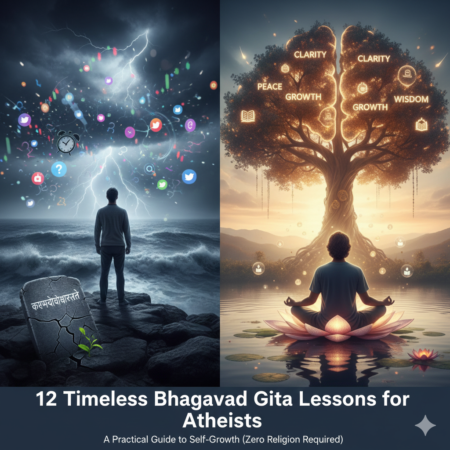
The Bhagavad Gita is often seen as a holy scripture meant only for believers, hence being an atheist I never looked at it closely. But when I actually sat down to understand it, I realized something powerful:
You don’t have to believe in God to learn from the Gita. You just have to believe in self-growth.
The Gita is less about religion and more about mindset, human behavior, psychology, discipline, and clarity in chaos.
And that’s why even an atheist can extract life-changing value from it.
In this post, I am sharing the Gita’s most practical lessons — explained in a simple, personal, relatable way — along with relevant quotes.
⭐ 1. Focus on Action, Not the Outcome (Nishkama Karma)

The Stress-Free Way to Work
Gita Verse (2.47): कर्मण्येवाधिकारस्ते मा फलेषु कदाचन । मा कर्मफलहेतुर्भूर्मा ते सङ्गोऽस्त्वकर्मणि ॥
Translation: “You have the right to perform your work, but not to the results. Do not let the fruits be your motive; and do not be attached to inaction.”
What it really means: You control effort, not outcomes. You can study, but you can’t control the question paper. You can work hard, but you can’t control the market.
Why it matters: Most stress comes from worrying about results we cannot influence. When I shifted to effort-first thinking, my anxiety reduced instantly.
Modern relevance: This principle is the basis of:
- Stoicism (The Dichotomy of Control)
- Cognitive Behavioural Therapy (CBT)
- High-performance productivity systems
How to apply:
- Give your best to the task
- Let go of overthinking the result
- Reduce expectation-driven stress
This single verse changed how I approach goals. When I stopped obsessing over results, life became lighter and productivity became natural. This is the Gita’s most liberating idea — and it requires zero religion.
⭐ 2. Your Mind Can Be Your Best Friend or Worst Enemy
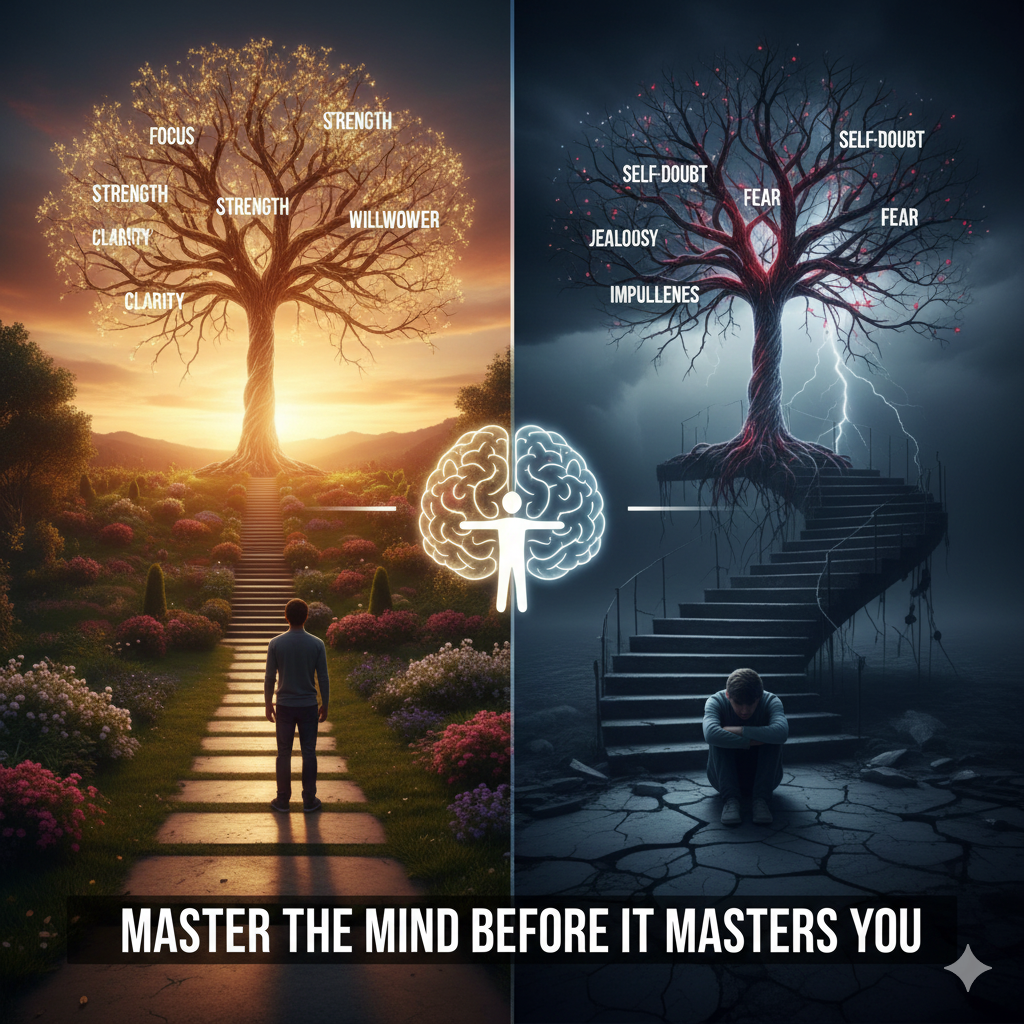
Master the mind before it masters you.
Gita Verse (6.5): उद्धरेदात्मनाऽऽत्मानं नाऽऽत्मानमवसादयेत् । आत्मैव ह्यात्मनो बन्धुरात्मैव रिपुरात्मनः ॥
Translation: “Lift yourself with your own mind. The mind can be your friend and your enemy.”
What it means: Your mind either empowers you or sabotages you.
Why it matters: On some days, you are focused, strong, positive. On others, your mind attacks you with: self-doubt, fear, jealousy, impulsiveness, negativity.
Modern relevance: This aligns with: mindfulness, emotional regulation, habit formation, therapy models.
How I apply it: I journal, I meditate for 5 minutes, I disconnect from noise — these are tools to make my mind my ally. When I started training my mind (journaling, silence, routines), life stopped feeling like a fight.
⭐ 3. Stay Balanced in Success and Failure — Sthita-Pragya State

Emotional stability is real strength.
Gita Verse (2.56): दुःखेष्वनुद्विग्नमनाः सुखेषु विगतस्पृहः । वीतरागभयक्रोधः स्थितधीर्मुनिरुच्यते ॥
Translation: “One who remains calm in sorrow, free from craving in joy, and beyond fear and anger — such a person is wise.”
Meaning: Don’t fly too high in success. Don’t sink too low in failure. Wisdom is accepting Duality.
Why it matters: I used to celebrate like crazy and break down as soon as something went wrong. It was exhausting. The Gita taught me to feel emotions but not be ruled by them.
Modern relevance: Therapists call this “emotional homeostasis” or equanimity.
How to apply:
- Celebrate, but stay grounded.
- Accept failures without self-hate.
- Don’t let external events control your inner peace.
Understanding this made me stop overreacting to small ups and downs. This mindset improves mental health immediately.
⭐ 4. Don’t Decide When You’re Overwhelmed

Clarity comes from detachment, not emotion.
Gita Verse (18.35): यया स्वप्नं भयम् शोकं विषादं मदमेव च । न विमुञ्चति दुर्मेधा धृतिः सा पार्थ तामसी ॥
Translation: “A confused or fearful mind clings to sleep, sorrow, and anxiety — this determination is destructive.”
Meaning: Decisions made during anger, fear, guilt, or panic are almost always wrong. Avoid Tamasic (confused/dark) determination.
Why it matters: Almost every bad decision I’ve taken came from emotional chaos.
Modern relevance: Neuroscience says the same — the emotional brain (limbic system) shuts down the logical brain (PFC).
How to apply:
- Take a break
- Remove yourself from pressure
- Evaluate calmly
- Think long-term
Whenever I’m emotionally charged, I delay decisions by a few hours or a night. This has saved me countless mistakes. After some time the mind becomes clearer and this helped me to not take stupid decisions.
⭐ 5. Understand Your Responsibility (Dharma)

Not religious duty — your ethical role in life.
Gita Verse (3.35): श्रेयान्स्वधर्मो विगुणः परधर्मात्स्वनुष्ठितात् ।
Translation: “It is better to do your own duty imperfectly than someone else’s duty perfectly.”
Meaning: “Dharma” simply means your specific role/duty: As a parent, As a friend, As a student, As a partner, As a citizen.
Why it matters: Running away from responsibility creates guilt and chaos. Owning your responsibilities gives direction and stability.
Modern relevance: This aligns with: Purpose-driven living, Accountability psychology.
How to apply: Identify your real-life roles and handle them with integrity.
⭐ 6. Let Go of Ego — It Is the Source of Most Suffering

Ego is louder than wisdom.
Gita Verse (16.4): दम्भो दर्पोऽभिमानश्च क्रोधः पारुष्यमेव च…
Translation: “Hypocrisy, arrogance, pride, and anger belong to those with destructive tendencies.”
Meaning: Ego causes conflict, resentment, rigidity, comparison, and broken relationships.
Why it matters: My biggest fights, lost friendships, and regrets were ego-driven, not logic-driven.
Modern relevance: Therapists call this “ego rigidity,” a cause of chronic stress.
How to apply:
- Accept mistakes
- Listen more
- Avoid unnecessary arguments
- Step back when the ego feels threatened
Every major fight in my life had ego at the root — not logic, not truth. Freedom begins where ego ends.
⭐ 7. Serve Others — Not for Heaven, But for Humanity

Small kindness > big peace.
Actual Gita Verse (3.20): लोकसंग्रहमेवापि सम्पश्यन्कर्तुमर्हसि ।
Translation: “Perform action for the welfare of the world.”
Meaning: Service doesn’t mean charity or religious duty. It means being helpful and compassionate.
Why it matters: Helping others makes you feel lighter, connected, and less self-obsessed.
Modern relevance: Psychology calls this the “helper’s high” (Endorphin release).
How to apply:
- Help someone without expecting anything
- Be a good listener
- Support someone emotionally
- Do small acts of kindness
Helping someone always gives me instant peace, more than achieving something for myself. This increases happiness more than material success.
⭐ 8. Detach From Unhealthy Attachments

Attachment > Desire > Fear > Anger > Suffering
Gita Verse (2.62–63): सङ्गात् संजायते कामः कामात्क्रोधोऽभिजायते । क्रोधाद्भवति सम्मोहः…
Translation: “Attachment leads to desire; desire leads to anger; anger leads to delusion.”
Meaning: Attachment is when your happiness depends on external things.
Why it matters: I used to attach happiness to people, expectations, outcomes, and validation. It always led to disappointment. Even buying everything that I desired there still will be more to buy and that cycle in never ending.
Modern relevance: This aligns with: Dependency issues, Attachment theory (secure vs. anxious), Emotional resilience.
How to apply:
- Love people, but don’t depend on them for self-worth
- Enjoy success, but don’t fear losing it
- Stay flexible with life
Detachment doesn’t mean caring less; it means suffering less.
⭐ 9. Accept the Things You Cannot Control

This is Gita + Stoicism + Modern psychology combined.
Gita Verse (2.14): शीतोष्णसुखदुःखदाः आगमापायिनोऽनित्याः…
Translation: “Cold and heat, pleasure and pain — these come and go. Endure them calmly.”
Meaning: You cannot control everything: other people, outcomes, timing, circumstances.
Why it matters: Accepting reality reduces bitterness, frustration, and stress.
Modern relevance: CBT calls this “radical acceptance.”
How to apply:
- Control your effort
- Let go of uncontrollable factors
- Stop fighting reality
I started looking at situations with a perspective, looked for things that I can control and those I cannot. Then I let go of the uncontrollable things. That led to peace because Peace begins where resistance ends.
⭐ 10. Practice Stillness — Even for 5 Minutes
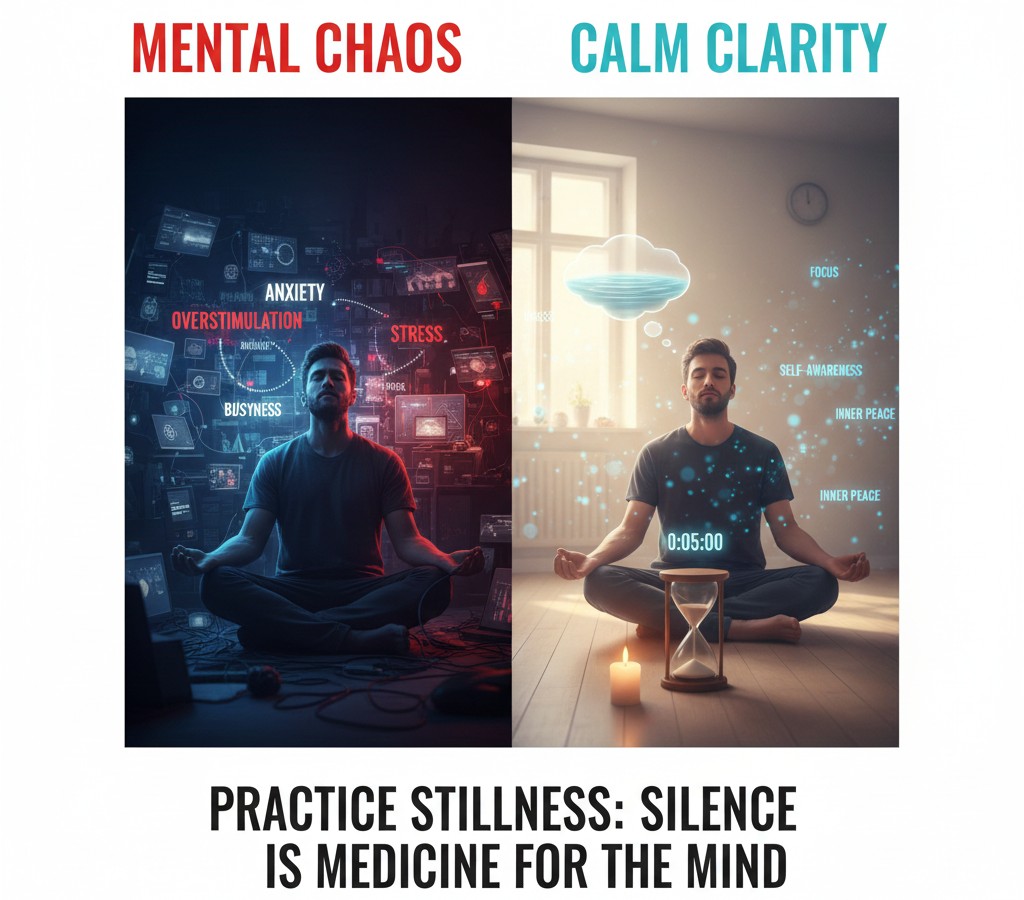
Meditation + calmness = mental clarity
Gita Verse (6.11–12): शुचौ देशे… मनः संयम्य… ध्यानयोगपरः ॥
Translation: “Sit in a clean, quiet place; control the mind; practice meditation for peace.”
Meaning: Silence is the medicine for mental chaos.
Why it matters: We live in overstimulation. Stillness helps reset the nervous system.
Modern relevance: Even 5 minutes of mindful breathing improves: focus, emotional stability, self-awareness.
How to apply:
- 5 minutes of mindful sitting
- Deep breathing
- Silence without phone
You feel lighter instantly.
⭐ 11. Keep Learning & Growing
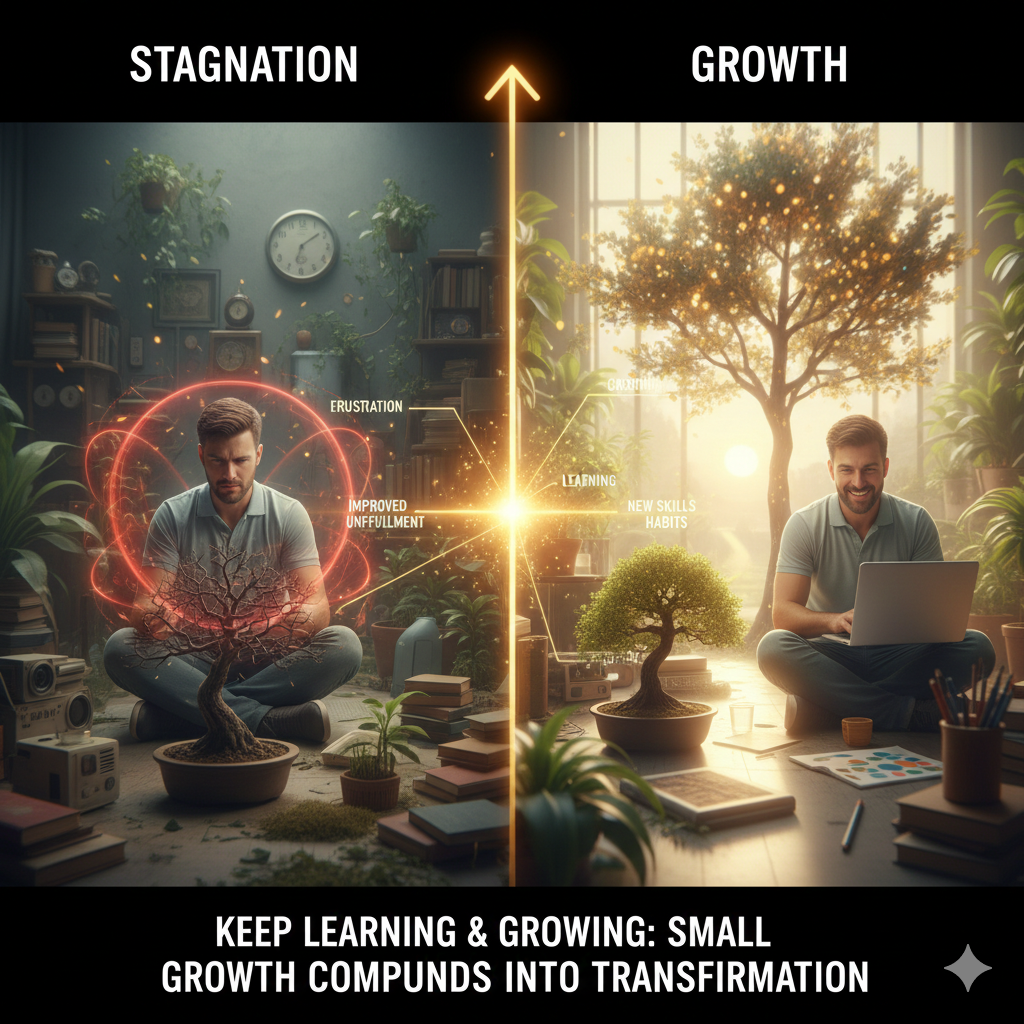
The Gita’s message: Evolve constantly.
Gita Verse (4.38): न हि ज्ञानेन सदृशं पवित्रमिह विद्यते ।
Translation: “There is nothing purifying in this world like knowledge.”
Meaning: Growth is not optional — it’s necessary.
Why it matters: Stagnation creates frustration. Growth creates fulfilment.
Modern relevance: Life-long learning is a major predictor of success (Growth Mindset).
How to apply:
- Read a few pages daily
- Learn a new skill
- Improve small habits
- Reflect weekly
I have a simple rule, do the things first that take 2 minutes, then approach the rest. This helps me clear the mind clutter. These are small yet powerful steps in our daily life. This Small growth compounds into transformation.
⭐ 12. Happiness Comes from Inner Stability, Not Outer Conditions
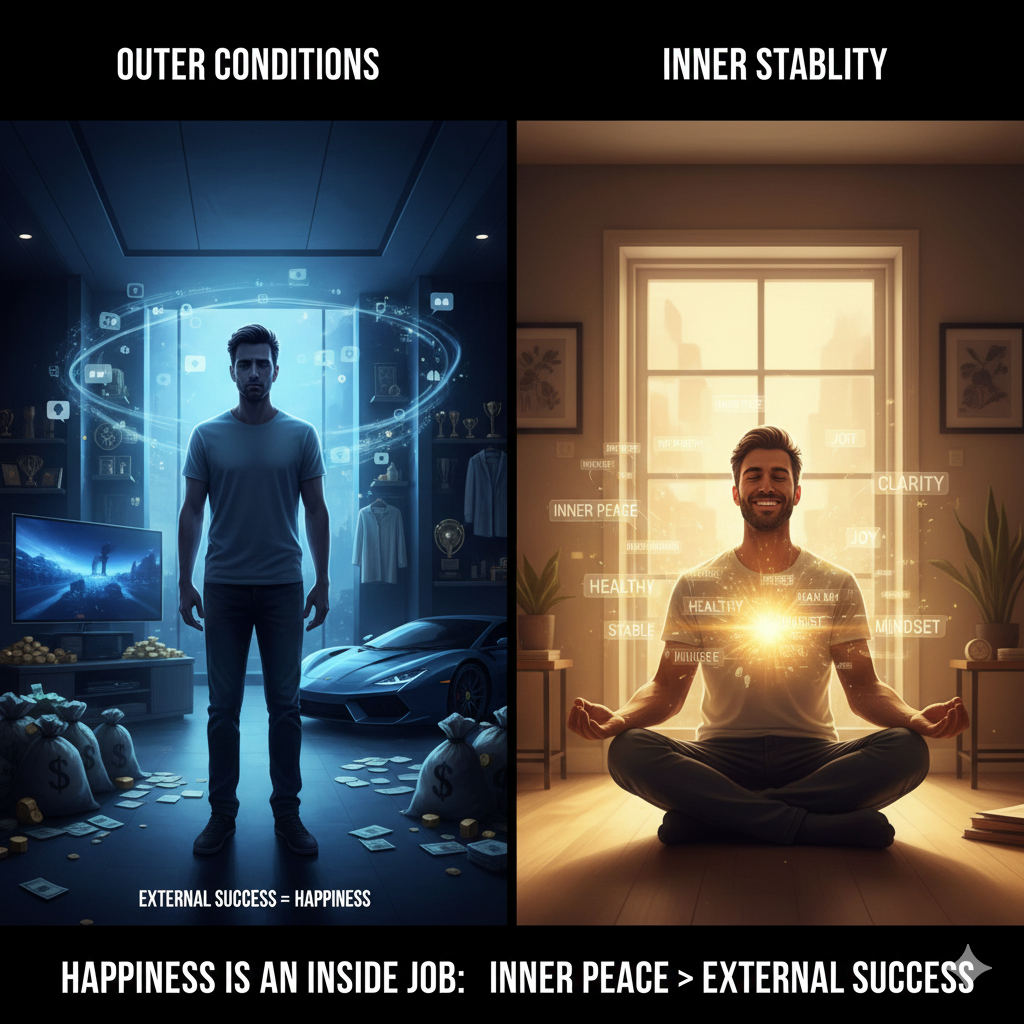
Inner engineering long before the term existed.
Gita Verse (5.24): योऽन्तःसुखोऽन्तरारामस्तथान्तर्ज्योतिरेव यः…
Translation: “A person whose happiness is within, whose light is within, is truly at peace.”
Meaning: External success doesn’t guarantee happiness. Inner peace does.
Why it matters: You can have money, love, recognition — and still feel empty. Happiness is an inside job.
Modern relevance: This is the foundation of mindfulness & positive psychology.
How to apply:
- Stop blaming circumstances
- Focus on inner clarity
- Build healthy habits
- Create a stable mindset
I ask myself regularly is that what I want or do I want it because someone else has it. Ask yourself this too before taking a decision. Think about it slowly, calmly. The more peaceful your mind, the better your life will feel and you won’t need any external validation for True happiness.
💛 Final Thoughts — The Gita Is Universal, Not Religious
You don’t need rituals. You don’t need belief. You don’t need spirituality.
The Gita is simply a handbook for the human mind.
Whether you’re atheist, agnostic, spiritual, or confused, these teachings help with:
✔ clarity
✔ emotional balance
✔ strength
✔ discipline
✔ wisdom
✔ peace
The Gita is not about God. It’s about understanding yourself.
And that makes it universal.

He is a Blogger and a YouTuber based in Jodhpur.
For years, he chased the 5 AM club, the perfect routines, and the “hustle”—and burnt out twice in the process. He realized that most productivity advice isn’t designed for the real world of traffic jams, family obligations, and noisy neighborhoods.
Through LifeLessonLab, he shares practical, “no-nonsense” systems to help you build a meaningful life without losing your mind.
Perfect 👌🏻