
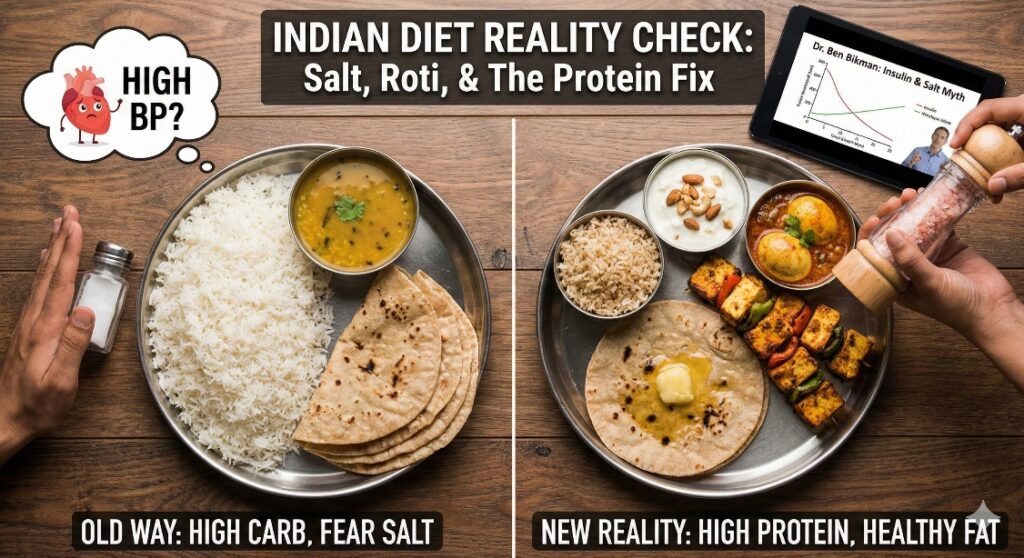
If you grew up in an Indian household like I did, you’ve heard this advice a thousand times: “Namak kam khana, BP badh jayega” (Eat less salt, your blood pressure will go up).
For years, I treated the salt shaker like it was radioactive. I ate bland salads and boiled veggies, thinking I was being the epitome of health. But recently, I watched a fascinating clip from The Diary Of A CEO featuring metabolic scientist Dr. Ben Bikman, and it completely shattered what I thought I knew.
It turns out, for those of us trying to stay healthy on a standard Indian diet, we might be fighting the completely wrong villain. It’s not the Salt (Namak). It’s the Insulin.
Here is what I learned from Dr. Bikman, and the hard truths I had to accept about my own “healthy” home-cooked meals.
The Great Salt Myth: Why We’ve Been Duped
Let’s be honest—when we get a high Blood Pressure reading, the first thing the doctor says is “cut the salt.”
But Dr. Bikman explains that this advice is outdated for most people. In large-scale studies where people drastically cut their salt intake, their blood pressure dropped by a “negligible” amount—sometimes just 1 or 2 points. That’s it. All that tasteless food for a statistical error?
The Real Villain? Insulin Resistance. Here is the science bit that blew my mind: The reason salt raises blood pressure is that Insulin tells your kidneys to hold onto it.
- High Insulin = Kidneys hoard salt = High Blood Pressure.
- Low Insulin = Kidneys flush salt naturally = Normal Blood Pressure.
The irony? If you cut salt too low, your body panics and tries to hoard it even more, which actually increases insulin resistance. By trying to fix my BP with low salt, I might have actually been making my metabolic health worse.
The Indian Dilemma: We Are “Carbitarians”
This is where it gets personal. We often call ourselves “Vegetarians” or “Non-Vegetarians,” but in reality, most Indians are “Carbitarians.”
We celebrate carbs at every meal:
- Breakfast: Poha, Upma, Paratha, or Idli (Carbs).
- Lunch: Roti and Rice (Carbs) with a side of Dal (mostly Carbs).
- Snack: Chai with Biscuits, Rusk, or Namkeen (Refined Carbs + Sugar + Palm Oil).
- Dinner: Repeat Lunch.
Dr. Bikman outlines 4 Pillars of Metabolic Health, and applying them to my desi lifestyle was a wake-up call. The biggest one? Protein.
The Deep Dive: How to ACTUALLY Get Enough Protein (And Why Dal Isn’t Enough)
This was the hardest pill for me to swallow. I used to think a bowl of Dal was my protein source.
Dr. Bikman emphasizes that we must prioritize protein to maintain muscle and control hunger. But here is the math that shocked me: You need roughly 30g of protein per meal to trigger muscle synthesis.
A bowl of Dal has only about 5-6g of protein (and 20g of carbs). You would need to eat 5 bowls of Dal to get enough protein, but by then, you’ve eaten so many carbs that your insulin is through the roof.
So, what should we actually eat? Here is my cheat sheet for high-protein Indian foods to swap into your diet.
1. The Vegetarian Powerhouses (Top Tier)
If you are vegetarian, you have to be intentional. You cannot stumble upon protein; you have to hunt for it.
- Paneer (Cottage Cheese): The King of Indian Veg Protein.
- Stats: ~18g protein per 100g.
- How to eat it: Raw with black pepper, grilled as Tikka, or scrambled (Bhurji). Don’t drown it in sweet gravy!
- Soya Chunks (Nutrela): Highly underrated.
- Stats: ~52g protein per 100g (uncooked). It is a protein bomb.
- How to eat it: Soya Bhurji, Soya Pulao (limit the rice), or add it to your vegetable curry.
- Greek Yogurt / Hung Curd:
- Stats: ~2x the protein of regular Dahi.
- How to eat it: Strain your regular Ghar-ka-Dahi in a muslin cloth for 2 hours. The whey water drains out, leaving creamy, high-protein curd. Eat it with nuts or berries.
- Whey Protein:
- Stats: ~24g protein per scoop.
- Myth: It’s not “steroids.” It’s just the isolated protein from milk. It is the easiest, cheapest way to hit your goals if you are pure veg.
2. The Non-Veg Essentials
If you eat meat, you have an advantage, but you need to avoid the “Butter Chicken Trap” (where you eat 2 pieces of chicken and 4 Naans with sugary gravy).
- Eggs: The perfect food.
- Stats: ~6g protein per egg.
- Goal: Don’t just eat one. Have 3 whole eggs for breakfast. That’s nearly 20g of protein right there.
- Chicken Breast:
- Stats: ~31g protein per 100g.
- Tip: Grill it or make a dry roast. Avoid deep-frying.
3. The “Pseudo-Proteins” (Handle with Care)
These are good, but they are primarily carbs or fats. Don’t count these as your main protein source.
- Dal/Lentils: Great for fiber, but high in carbs. Treat them as a side dish, not the main event.
- Nuts (Almonds/Walnuts): Great fats, but low protein-to-calorie ratio.
- Chana/Chickpeas: Healthy, but very high carb.
Pillar 3: Don’t Fear Fat (Bring Back the Ghee!)
Nature rarely provides protein without fat. Dr. Bikman explains that eating protein with fat leads to better digestion and muscle growth.
Growing up, we were told Ghee would give us heart attacks. Now, I’m adding a spoonful of Ghee back onto my (single) Roti without guilt. It keeps me full longer so I don’t reach for that packet of Bhujia two hours later.
- My Swap: Instead of cooking vegetables in refined sunflower oil (which is highly processed), I’ve switched back to Ghee, Coconut Oil, or Mustard Oil (Sarson ka tel).
Pillar 4: Fasting & Exercise (The Indian Context)
Fasting the Right Way
Indians are the OGs of fasting (Navratri, Ekadashi). But let’s be real—we usually “fast” by eating Sabudana Khichdi (pure starch) and fried potatoes.
I’ve started doing Intermittent Fasting (16:8 method). I finish dinner by 8 PM and don’t eat until 12 PM the next day. But crucially, when I break my fast, I do it with Protein (Eggs or Paneer), not a sugar spike like sweet tea or fruit juice.
Why Walking Isn’t Enough
In India, the “Morning Walk” is considered the ultimate fitness routine. While walking is great for the mind, Dr. Bikman says Muscle is Medicine.
Muscle is the main place our body burns glucose. If you want to eat Roti and get away with it, you need muscle to burn that sugar. I’ve realized we need to stop just walking and start doing resistance training—pushups, squats, or lifting dumbbells at least at home.
My Final Takeaway
This video changed my approach from “Low Salt” to “Low Sugar / High Protein.”
If you are struggling with belly fat, fatigue, or blood pressure, look at your plate today.
- Is it 80% Rice/Wheat?
- Where is the Protein?
- Are you snacking on biscuits?
Let’s enjoy our pinch of salt in our Nimbu Pani, but let’s be a lot more careful with the sugar in our Chai.
Credits & Resources
- The Expert: Dr. Ben Bikman, PhD. He is a metabolic scientist and a professor of Cell Biology and Physiology. You can find his book “Why We Get Sick” and more of his research at his website: BenBikman.com.
- The Video: This post was inspired by the clip “What Men & Women NEED To Know About Salt” from the podcast The Diary Of A CEO with Steven Bartlett. It is a must-watch for anyone confused about nutrition.
Disclaimer: I am a blogger sharing my personal journey, not a doctor. This post is based on my interpretation of a health video. Always consult your doctor before making major diet changes, especially if you have kidney issues or are on medication.
This is the original video clip where Dr. Ben Bikman explains the misconceptions about salt and insulin resistance which formed the basis of this blog post.
He is a Blogger and a YouTuber based in Jodhpur.
For years, he chased the 5 AM club, the perfect routines, and the “hustle”—and burnt out twice in the process. He realized that most productivity advice isn’t designed for the real world of traffic jams, family obligations, and noisy neighborhoods.
Through LifeLessonLab, he shares practical, “no-nonsense” systems to help you build a meaningful life without losing your mind.
Pingback: How to Be More Productive Every Day — Without Burning Out