
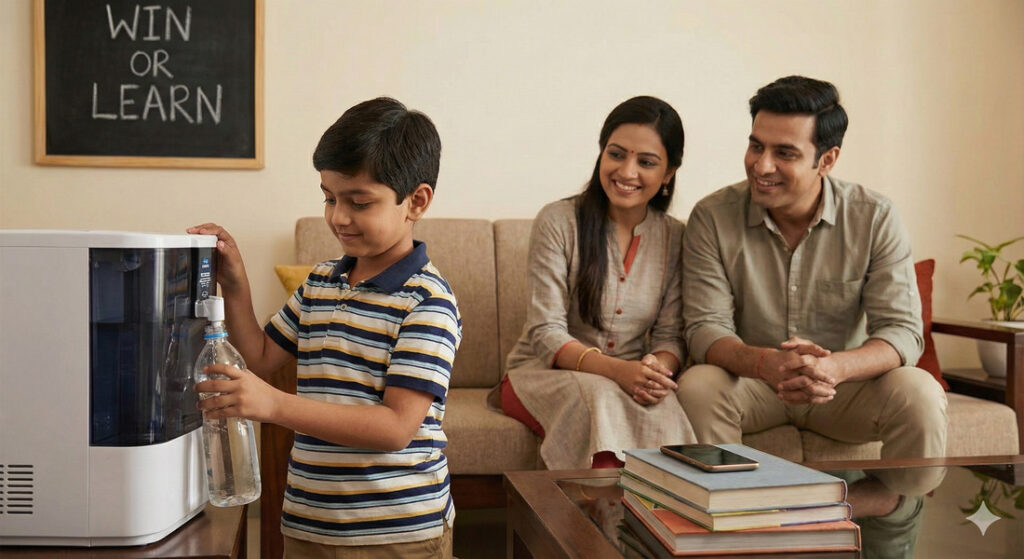
If you are an Indian parent reading this, I want you to take a deep breath.
We live in a society that is obsessed with outcomes. From the moment our children enter nursery, the race begins. It’s a race for the best grades, the best extracurriculars, the best college placements (IIT, AIIMS, or Ivy League—pick your poison), and eventually, the best package. We love our children fiercely. In India, parenting isn’t just a duty; it’s an emotion. We often measure our own worth by our child’s success. If they score 98%, we feel like we scored 98%. If they falter, we feel like failures.
But recently, I watched a conversation on raising mentally resilient kids that shook me. It was an interview between Jay Shetty and Dr. Daniel Amen, a renowned psychiatrist and brain expert. They discussed “How To Raise Mentally Resilient Children,” and it forced me to look in the mirror.
Are we, in our deep love and desire to protect our kids, actually weakening them? Are we preparing the road for the child instead of preparing the child for the road?
In this post, I’m going to break down the incredible science-backed insights from this conversation, but I’m going to filter them through our chaotic, loving, and high-pressure Indian reality. If you’ve ever done your child’s science project at 11 PM or argued with a teacher about a mark, you need to read this.
The Trap of “Over-Functioning” Parents
Dr. Amen starts with a punch to the gut: “You do not solve all of your children’s problems. That is the heart of love and logic.”
In India, we often confuse “caring” with “doing.” I see this everywhere.
- The 10-year-old who doesn’t know how to pack their own school bag because Mom does it.
- The teenager who doesn’t know how to book an Uber or negotiate with a rickshaw driver because Dad always drops them.
- The college student who can’t cook a basic meal because the domestic help or Nani/Dadi always fed them by hand.
Dr. Amen calls this robbing a child of their agency. When we solve their problems, we send a subtle but toxic message: “You are not competent enough to handle this. I must do it for you.”
He shared a story about his daughter, Chloe. She wasn’t doing her homework. As a parent, the instinct is to nag, to fight, or worse—to sit and do it for them. Dr. Amen’s wife, Tana, did something radical. She told Chloe, “I have already passed second grade. This is on you. If you don’t do it, you explain it to your teacher.”
Chloe didn’t do it. She faced the consequences at school. She came back, realized the world didn’t end but that she didn’t like the feeling of being unprepared, and she never needed to be asked again. Today, she is a high-achieving, independent woman.
The Indian Takeaway: We are terrified of “consequences.” We think if our child forgets their homework, the teacher will yell, their internal marks will drop, and their future is ruined. We need to stop “fortune-telling” (predicting disaster). Let them forget the tiffin box once. Let them get a scolding for a missing assignment. Small failures when the stakes are low (primary school) build the muscles for handling big failures (career, relationships) when they are adults.
Core Principle 1: Clarity – What is Your Goal?
Dr. Amen asks a simple question: “What kind of parent do you want to be, and what kind of child do you want to raise?”
If I asked you this at a dinner party, you might say, “I want my child to be happy and successful.” But our actions often say, “I want my child to be obedient and impressive to my relatives.”
We need to define our goals clearly.
- Do you want a compliant child? Then yell, threaten, and solve their problems. They will obey you, but they will likely be anxious followers in life.
- Do you want a mentally strong child? Then you must value resilience over obedience.
Dr. Amen mentions that mentally strong kids live by clearly defined goals. But this starts with us. We have to model it. If we are anxious, stressed, and constantly seeking validation from others (the “Log Kya Kahenge” virus), our children will absorb that anxiety. You cannot raise a mentally strong child if you are a fragile parent.
The “Silent Father” Syndrome: Redefining the Indian Dad
Dr. Amen shared a poignant reflection about his own upbringing. His mother was present and fun, but his father was “gone”—physically there, perhaps, but emotionally absent or strictly authoritarian.
This hits home for many of us. In the traditional Indian setup, the father’s role was often limited to “The Provider” and “The Enforcer.” Dad earns the money, and Dad signs the report card. Emotional nurturing was left entirely to the mother.
But Dr. Amen’s research shows that this model is outdated and dangerous for a child’s mental strength.
- The “Scary Dad” Issue: If a child fears you, they will lie to you. Dr. Amen mentioned that when he turned 18, he voted for a candidate his father hated, just to spite him. Lack of relationship leads to rebellion, not respect.
- The “Disengaged Dad” Issue: If you are only involved when something goes wrong (bad marks, discipline issues), your child associates you with stress.
The Shift to “Consultant Dad”:
Fathers, we need to move from being the “High Court Judge” of the house to being the “Senior Consultant.”
- Physical Touch: Hug your sons. In India, we often stop hugging boys after they hit 10 or 11. Dr. Amen emphasizes that bonding reduces cortisol (stress hormone). Your son needs your physical reassurance that he is safe.
- Interest over Interrogation: Instead of asking “How much did you score in Maths?”, ask “What is the coolest thing you learned about space today?” or “Show me how this video game works.”
- Vulnerability: Admitting you are wrong. Dr. Amen talks about repairing bonds. Nothing builds a child’s respect for a father more than hearing, “I’m sorry I yelled earlier. I had a rough day at the office, and I took it out on you. That was my mistake.” This doesn’t make you weak; it makes you a human they can trust.
Core Principle 2: The Magic of “Special Time” (Bonding)
This was my favorite part of the discussion, and it’s the most practical tool you can use today.
We are busy. Between the Bangalore traffic, the Mumbai local commute, or just the grind of corporate jobs in Gurgaon, we are exhausted. We think we spend time with our kids because we are in the same house. But are we connecting?
Dr. Amen prescribes “Special Time.”
- Duration: 20 minutes a day.
- The Rules: No commands. No questions. No directions.
- The Activity: Whatever the child wants to do (within reason).
Why “No Questions”? Think about your average conversation with your child after school:
- ”How was school?”
- ”Did you eat your tiffin?”
- ”Do you have homework?”
- ”Why is your uniform dirty?”
It’s an interrogation! Dr. Amen says that when we constantly direct and question, the relationship becomes transactional. The child shuts down.
Instead, spend 20 minutes just being. If they are playing with Lego, you play with Lego. Don’t say, “Build a tower.” Say, “Wow, you are using the red block.” Just notice. Listen.
The Result: He shared a story of a literary agent whose daughter wanted nothing to do with him. After 3 weeks of “Special Time,” she wouldn’t leave his leg. She was starving for connection, not correction. In our Indian joint families or busy nuclear setups, we often assume connection happens automatically. It doesn’t. It must be intentional.
Core Principle 3: Discipline – The “Love and Logic” Approach
There is a fascinating study Dr. Amen cited about 10,000 families. They looked at parenting styles across two axes: Firm vs. Permissive and Hostile vs. Loving.
The outcomes were shocking:
- Hostile & Firm: Not good (creates anxiety/rebellion).
- Loving & Permissive: The second worst outcome.
- Loving & Firm: The best outcome.
The Danger of “Loving & Permissive” in India:
We often swing between extremes. We are either the “Strict Military Parent” or the “Pampering Parent” (often the role of grandparents, but increasingly parents too). We think “Loving” means giving them whatever they want—the iPad, the chocolate, the late curfew.
Dr. Amen warns that children need boundaries. A child without boundaries is an anxious child. They need to know where the wall is.
The “Love and Logic” method:
- Step 1: Empathy/Love. “I love you too much to argue.”
- Step 2: Consequence. “You can play video games after your room is clean. It’s your choice.”
Notice the shift? It’s not “Clean your room or I will hit you.” It is “You have the control. You decide when you play by deciding when you clean.” This builds agency.
The Neuroscience: Why We Can’t Treat Kids Like Mini-Adults
This is where Dr. Amen’s brain expertise shines. He talks about Myelination.
The Prefrontal Cortex (the front part of the brain responsible for judgment, impulse control, and planning) does not finish developing until age 25.
- This is why your teenager does stupid things.
- This is why they choose the risky bike ride or the procrastinated study schedule.
The “Frontal Lobe” Loan:
Dr. Amen says, “God gave us parents to be the frontal lobes until theirs develop.”
This creates a delicate balance. We need to be their guidance system (because their brain isn’t ready), but we shouldn’t be their pilot.
- Guidance: “If you stay up all night gaming, you will feel terrible for your exam tomorrow. I suggest you sleep.”
- Control: Taking the console away and screaming.
- Neglect: “Do whatever you want.”
We need to be the “Consultant” to our kids, not the “Manager.”
The Modern Enemy: Digital Addiction & Brain Health
You cannot talk about resilience without talking about the phone. Dr. Amen calls the smartphone a dopamine-dispensing machine that numbs the pleasure centers of the brain.
He shared a terrifying case of a child who smashed furniture when his video games were taken away. Brain scans showed his brain looked like a drug addict’s. When he stopped, his brain healed.
The Rule: Delay access as long as possible.
I know, I know. “But all his friends have a phone!” “He will be left out of the WhatsApp group!”
Dr. Amen’s response? “I love you too much to let you damage your brain.”
In India, we often use the phone as a babysitter. We hand the toddler a phone so we can eat dinner in peace at the restaurant. We are wiring their brains for distraction.
Practical Tip: No phones at the dinner table. For anyone. Not even Dad checking his work emails. We have to model the behavior.
Tactical Strategies: Winning the Screen Time War in an Indian Home
Dr. Amen’s warning about “delayed access” is powerful, but let’s be real—implementing this in an Indian household is a battlefield. We aren’t just fighting the child’s desire; we are fighting a culture that has moved entirely online. Here is how we apply the science of resilience to the digital dilemma without turning the house into a war zone.
1. The “WhatsApp Family Group” Trap
In India, the smartphone isn’t just a toy; it’s a social lifeline. Your child sees you laughing at memes on the extended family group or arguing with the RWA (Residents Welfare Association) on WhatsApp.
The Fix: Dr. Amen emphasizes modeling. If you want your child to disconnect, you must narrate your own disconnection.
- Say it out loud: “I am putting my phone in the drawer now because I want to focus on our ludo game.”
- The Bedroom Rule: Buy an old-school alarm clock (they cost ₹300 on Amazon). Charge all phones in the living room overnight. Nothing destroys a child’s sleep (and mental health) faster than the blue light and the anxiety of late-night notifications from friends.
2. Gaming: The “Vegetable First, Dessert Later” Approach
Dr. Amen notes that gaming deactivates the frontal lobes. But banning it entirely often leads to rebellion (the “forbidden fruit” effect).
The Strategy: Treat gaming like dessert. You don’t eat Gulab Jamun before your dal and rice.
- The Protocol: High-dopamine activities (gaming, reels, YouTube) are only allowed after low-dopamine activities are complete.
- Homework done? Check.
- Room cleaned? Check.
- 20 minutes of physical play/exercise? Check.
- The Logic: This teaches the brain to earn dopamine through effort, rather than getting it for free. This is the biological definition of resilience—the ability to work through “boring” tasks to get a reward.
3. The “Boredom” Blueprint
We are terrified of our children being bored. If they whine “I’m bored,” we shove a screen in their face to keep the peace.
The Truth: Boredom is where creativity and resilience are born.
When your child complains about boredom, don’t fix it. Say, “That sounds like a great opportunity to use your imagination.” It will be painful for the first 20 minutes. They will whine. But eventually, the brain will seek stimulation internally. They will pick up a book, start drawing, or annoy their sibling (which is also a social skill in disguise!). Let them be bored. It is good for their neurons.
Biological Resilience: It’s Not Just “Mindset”
Resilience is physical. Dr. Amen talks about the 4 Circles of Health:
- Biological: How is the brain working? (Diet, sleep, genetics).
- Psychological: How are they thinking?
- Social: Who are they hanging out with?
- Spiritual: Do they have a sense of purpose?
The Diet Connection:
He specifically mentioned Red Dye 40 (common in candies, cheap juices, and many processed “tasty” snacks we find in local kirana stores) and how it caused rage in one of his patients.
In India, we love our sweets, our chips, and our packaged masala munchies. If your child is having “behavioral issues,” look at their plate before you look for a psychologist. Are they sleeping? Are they eating real food or just sugar and preservatives? A tired, malnourished brain cannot be resilient.
The “Guilt Cycle” and Repairing Bonds
We all mess up. We yell. We say things we shouldn’t.
Dr. Amen describes the Guilt Cycle:
- Child misbehaves.
- Parent ignores it (too tired/don’t want conflict).
- Behavior gets worse.
- Parent explodes/Yells.
- Parent feels guilty.
- Parent gives in or “spoils” the child to make up for the yelling.
- Child learns that “If I push hard enough, Mom/Dad will eventually give in.”
How to break it?
Deal with the behavior in the moment with a calm, firm voice.
“I can see you are upset. But we do not hit. Sit here until you are calm.”
And if you do mess up? Repair it. “I lost my temper. I am working on my patience just like you are working on yours.”
This teaches the child that mistakes are part of growth. As Dr. Amen says, “Every day, I win or I learn.”
FAQ: Real Indian Scenarios Solved with “Love & Logic”
Based on Dr. Amen’s principles, let’s tackle three specific headaches every Indian parent faces.
Scenario 1: The “Nakhre” at Dinner Time
The Situation: Your 8-year-old refuses to eat the Lauki (Bottle Gourd) or Dal you made and demands Maggi or ordering a pizza.
- The Old Way: “Eat it quietly or I will slap you!” OR “Okay, okay, I will make you a cheese sandwich.”
- The “Resilient” Way: “I understand you don’t like Lauki. That is fine. You don’t have to eat it. But the kitchen is closed until breakfast tomorrow. I love you, and I’m sure you’ll be hungry enough to eat a big breakfast.”
- Why this works: You aren’t forcing food (which creates eating disorders), but you aren’t catering to demands. Hunger is a natural consequence. They won’t starve in one night, but they will learn that you are not a short-order cook.
Scenario 2: The Teenager’s “Privacy” Argument
The Situation: Your 14-year-old locks their bedroom door for hours and says, “It’s my life, I need privacy.”
- The Old Way: Breaking the door down or passively allowing total isolation.
- The “Resilient” Way: “I respect your need for space. However, in this house, we don’t lock doors because isolation isn’t good for our brains. You can close the door, but we keep it unlocked for safety. Also, Wi-Fi is available in the common areas, not in the bedroom after 9 PM.”
- Why this works: It balances the biological need for autonomy with the parental duty to prevent the dangers of isolation and unmonitored internet usage.
Scenario 3: The “Everyone Else is Going” Meltdown
The Situation: Your child wants to go to a late-night party or a trip to Goa because “All my friends are going,” but you feel they aren’t ready or it’s unsafe.
- The Old Way: “Because I said so!”
- The “Resilient” Way: (Using Dr. Amen’s ‘Listen and Repeat’ technique).
- Parent: “So, you feel left out because everyone is going?”
- Child: “Yes! You are ruining my social life!”
- Parent: “I can hear how angry you are. It hurts to feel left out. But my job is to keep your brain and body safe until you are 25. This environment isn’t safe yet. I love you too much to say yes, even if it makes you mad at me right now.”
- Why this works: You validate their feeling (Fomo is real!) without compromising on the boundary. You accept being the “bad guy” in the short term to protect them in the long term.
Conclusion: The Secret to Raising Mentally Resilient Kids is Love
This video forced me to redefine love.
We think love is sacrifice. We think love is driving them to 5 different tuition classes. We think love is worrying about their future.
But Dr. Amen suggests that Love is:
- Time: Undivided, listening time.
- Boundaries: The safety of “No.”
- Agency: The trust that they can handle failure.
- Self-Care: Taking care of your own mental health so you can be a present parent.
He ended with a powerful thought: “I don’t do things for people who do not treat me with respect.”
This applies to our kids too. If we allow our children to treat us like doormats or servants, we are raising entitled adults who will be miserable in their marriages and jobs.
Raising a mentally resilient child in India today is an act of rebellion. It means saying “No” to the rat race. It means valuing character over marks. It means letting them fall down so they learn how to get up.
It’s hard. It’s scary. But as Dr. Amen says, we are playing the long game. We aren’t raising children; we are raising the adults they will become.
Let’s start with 20 minutes of Special Time today. No questions asked.
Key Takeaways for the Indian Parents
- Stop the “Helicoptering”: Let them pack their bag. Let them forget their homework. Let them face the teacher.
- The 20-Minute Rule: dedicate 20 mins daily to “Special Time”—no commands, no questions.
- Check the Diet: Cut out artificial colors and excessive sugar which fuel hyperactivity.
- Model Resilience: Share your own struggles and how you overcame them. Don’t be a “perfect” hero; be a real human.
- Firm but Kind: Boundaries are not optional. Love does not mean permissiveness.
Did this resonate with you? How do you handle the pressure of parenting in a competitive world? Drop a comment below!
References & Credits:
- This post is inspired by the episode “The Brain Expert: How To Raise Mentally Resilient Children” on the Jay Shetty Podcast.
- Expert insights provided by Dr. Daniel Amen, psychiatrist and founder of Amen Clinics.
- Watch the full insightful video here:

He is a Blogger and a YouTuber based in Jodhpur.
For years, he chased the 5 AM club, the perfect routines, and the “hustle”—and burnt out twice in the process. He realized that most productivity advice isn’t designed for the real world of traffic jams, family obligations, and noisy neighborhoods.
Through LifeLessonLab, he shares practical, “no-nonsense” systems to help you build a meaningful life without losing your mind.