
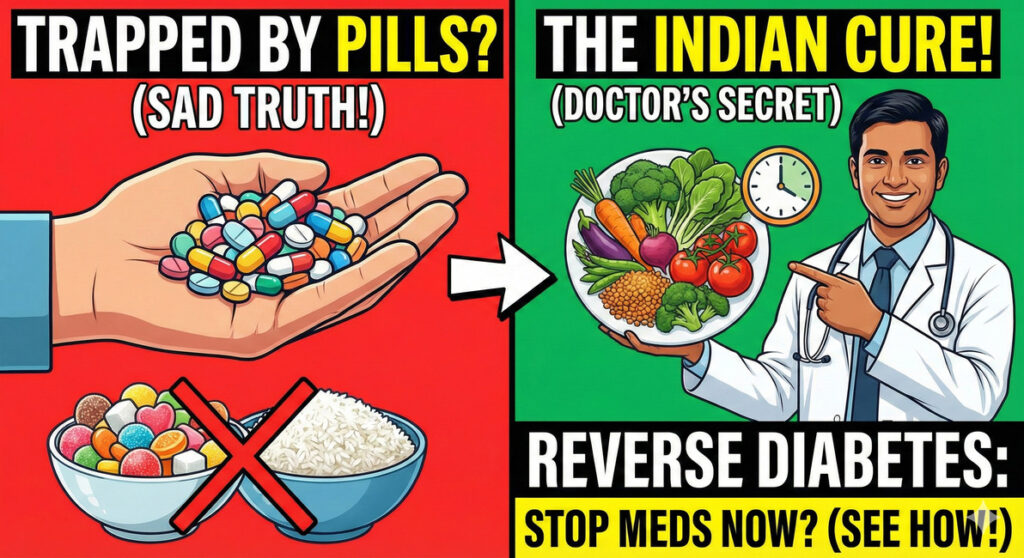
If you walk into any average Indian household today, you will likely find a familiar, silent guest sitting at the dining table: Type 2 Diabetes. It is no longer a disease of the elderly; it is affecting our parents, our spouses, and increasingly, our children. India is frequently dubbed the “Diabetes Capital of the World,” a title we should neither be proud of nor accept as our destiny. But here is the good news: you can reverse Type 2 diabetes.
For decades, the standard medical advice given to Indian patients has been consistent: “Take your Metformin,” “Eat small frequent meals,” and “Control your sugar.” Yet, despite strict adherence to these rules, millions of Indians watch their dosage increase year after year. They move from one tablet to two, then to insulin injections, all while developing complications like neuropathy, kidney issues, and heart disease.
What if the advice was wrong? What if we have been treating the symptom (high blood sugar) while ignoring the root cause?
Dr. Pradip Jamnadas, a renowned interventional cardiologist, argues that Type 2 Diabetes is not a life sentence. It is a dietary disease that requires a dietary cure. Drawing from his powerful lecture “Reversing Diabetes – The Roles Medication and Diet Play” and his broader teachings on fasting and metabolic health, this guide outlines a path to reverse Type 2 diabetes completely, not just manage it.
It is time to unlearn what we know about diabetes and reclaim our health.
Part 1: The Illusion of “Control”
Why Medication Alone Is Not the Answer
When you are diagnosed with diabetes, the immediate goal is usually to lower your HbA1c (a marker of average blood sugar over three months). Doctors prescribe medications, and when the number drops from 8.0 to 7.2, we celebrate. We think the disease is under control.
Dr. Jamnadas exposes a harsh truth: lowering blood sugar is not the same as curing diabetes.
He references a major study published in the New England Journal of Medicine (The GRADE Study) that followed over 5,000 diabetic patients for five years. These patients were given various combinations of standard diabetes drugs (Metformin plus Insulin, Glimepiride, Liraglutide, or Sitagliptin). The goal was to keep their A1c below 7.0%.
The results were shocking:
- 71% of participants failed to maintain an A1c of less than 7.0% using these drug combinations.
- The average reduction in A1c was a meager 0.3%.
- Over 30% of patients experienced significant side effects, including gastrointestinal issues and weight gain.
Most importantly, despite the drugs, the disease progressed. The underlying condition got worse. Why? Because diabetes medications generally work by forcing the body to produce more insulin or by shoving sugar out of the blood and into the cells. They hide the sugar, but they don’t get rid of the problem causing the sugar to pile up in the first place.
Dr. Jamnadas puts it simply: You cannot drug your way out of a disease caused by diet.
Part 2: The Root Cause – It’s Not Just Sugar, It’s Insulin
To reverse Type 2 diabetes, we must understand what it actually is. We often think diabetes is a problem of “high blood sugar.” That is only half the story.
Type 2 Diabetes is a disease of Hyperinsulinemia (too much insulin) and Insulin Resistance.
The “Overflowing Suitcase” Analogy
Imagine your body’s cells are like a suitcase. When you eat, your body breaks food down into glucose (sugar), and your pancreas releases a hormone called insulin. Insulin’s job is to open the suitcase (the cell) and pack the clothes (sugar) inside to be used as energy.
In a healthy person, the suitcase is empty, and packing is easy.
In a diabetic person, the suitcase is already bursting at the seams. It is full of fat and sugar from years of overeating and frequent eating. When insulin tries to stuff more sugar in, the cell resists. It says, “No more!” This is Insulin Resistance.
So, your pancreas works harder. It pumps out more insulin to force the suitcase shut. This works for a while, keeping your blood sugar normal, but your insulin levels are sky-high. Eventually, the pancreas can’t keep up, the sugar spills over into the bloodstream, and you are diagnosed with diabetes.
The Indian Context: The Carbohydrate Catastrophe
In India, our “suitcase” gets filled very quickly because of the nature of our diet.
- The “Healthy” Indian Plate: We believe a meal of 3 rotis, a bowl of rice, and a small katori of dal is healthy. In reality, this is a massive load of glucose.
- The Snack Culture: We don’t just eat lunch and dinner. We have chai and biscuits in the morning, a mid-morning snack, lunch, evening chai with namkeen or samosa, and then a late dinner.
- The Result: Every time we eat, we spike insulin. If we eat 5-6 times a day, our insulin is always high. We never give our body a chance to open the suitcase and unpack (burn fat).
Part 3: How to Reverse Type 2 Diabetes with the Jamnadas Protocol
Dr. Jamnadas’s approach to reversing diabetes is based on two pillars: What you eat and When you eat. The goal is to lower insulin levels so the body can finally heal.
Pillar 1: The “No-Whitewash” Diet
The modern food industry has stripped fiber from our food to make it shelf-stable and hyper-palatable. Dr. Jamnadas emphasizes that fiber is the antidote to diabetes.
When you eat whole foods with fiber, two magical things happen:
- The Mesh Effect: Soluble fiber forms a gel-like mesh in your intestines. This traps the sugar and starch, slowing down absorption. Instead of a massive sugar spike (and a massive insulin spike), you get a slow, gentle release of energy.
- Feeding the Good Guys: We have 100 trillion bacteria in our gut. They eat what we can’t digest—fiber. When you eat fiber, these bacteria produce Short-Chain Fatty Acids (SCFAs). These SCFAs reduce inflammation, heal the gut lining, and crucially, improve insulin sensitivity.
The “Indian Kitchen” Rules for Reversal:
- Eliminate the “Three Whites”:
- White Sugar: In tea, sweets (mithai), and hidden in packaged foods.
- White Rice: It is essentially pure glucose.
- White Flour (Maida): Found in naan, kulcha, biscuits, bread, samosas, and rusks.
- Stop the “Ground Up” Grains:
- Dr. Jamnadas warns against “powdered stuff.” Even whole wheat flour (atta), once ground into a fine powder, absorbs very quickly into the blood.
- Action: Minimize roti consumption initially. If you must eat grains, choose them in their whole form (like broken wheat/dalia or whole millets) rather than fine flour.
- Embrace “Above Ground” Vegetables:
- Focus on fibrous vegetables: Bhindi (Okra), Baingan (Eggplant), Gobi (Cauliflower), Beans, Karela (Bitter Gourd), and leafy greens (Palak/Methi).
- Caution: Be careful with starchy “below ground” vegetables like potatoes and sweet potatoes during the reversal phase.
- Protein & Fat are Friends:
- For non-vegetarians: Eggs, chicken, and fish are excellent as they do not spike insulin.
- For vegetarians: Paneer, tofu, and legumes (whole moong, chana, rajma) are good. While legumes have carbs, they are wrapped in fiber, making them infinitely better than rice or roti.
- No Processed Oils:
- Switch away from inflammatory refined vegetable oils (sunflower, soybean, canola). Use traditional fats like Ghee, Coconut Oil, or Mustard Oil (Kacchi Ghani).
Pillar 2: The Power of Fasting (Time-Restricted Eating)
This is the game-changer. You cannot reverse insulin resistance if you are constantly eating. Dr. Jamnadas states, “The biochemistry of the body was made for feeding and fasting cycles.”
When you fast, insulin levels drop. When insulin drops, the body finally gets the signal to open the “suitcase” and start burning the stored sugar and fat.
Why the “Eat Small Frequent Meals” Advice is Wrong:
Many Indian dieticians tell diabetics to eat every 2 hours to “prevent low sugar.” This keeps insulin permanently elevated, ensuring the disease never goes away. To reverse the disease, we need periods of low insulin.
Part 4: Your Step-by-Step Action Plan
Start Today. No expensive supplements required.
Phase 1: The Clean-Up (Weeks 1-2)
Goal: Break the sugar addiction and stabilize energy.
- Step 1: The Kitchen Raid. Throw away biscuits, rusks, namkeen, white bread, and sugary drinks. If it’s in the house, you will eat it.
- Step 2: Fix Your Chai. This is the hardest part for Indians.
- Bad: Chai with milk and 2 spoons of sugar.
- Better: Chai with milk and Stevia or Monk Fruit (natural sweeteners).
- Best: Black tea, Green tea, or Black coffee without sugar.
- Step 3: The Roti/Rice Ration.
- Cut your portion of rice and roti by 50%.
- Triple your portion of Sabzi (vegetables) and Dal.
- Start every meal with a bowl of raw salad (cucumber, tomato, radish). The fiber will buffer the glucose spike from the rest of the meal.
- Step 4: Stop Snacking. Eat breakfast, lunch, and dinner. Nothing in between. No “chai-biskut” at 4 PM. If you are thirsty, drink water or green tea.
Phase 2: Compressing the Window (Weeks 3-4)
Goal: Introduce Intermittent Fasting (16:8 Protocol).
- The Protocol: You will eat all your meals within an 8-hour window and fast for 16 hours.
- How to do it in an Indian Home:
- Skip the morning bed tea.
- 11:00 AM: Brunch. (e.g., Omelette/Paneer bhurji, a big bowl of vegetables, maybe 1 small missi roti).
- 3:00 PM: (Optional) A handful of nuts (almonds/walnuts) or a cup of green tea.
- 7:00 PM: Dinner. (e.g., Dal, Sabzi, Salad. Try to skip the grains entirely at dinner).
- 7:00 PM to 11:00 AM: FAST. Water only.
- Why this works: The 16-hour break allows your insulin to drop to baseline levels every single day.
Phase 3: The Deep Clean (Month 2 onwards)
Goal: Accelerate reversal and autophagy.
- Once you are comfortable with 16:8, Dr. Jamnadas suggests pushing the envelope.
- 24-Hour Fasts: Once or twice a week, go from dinner to dinner.
- Example: Finish dinner at 7 PM on Monday. Don’t eat again until 7 PM on Tuesday.
- This forces the body to burn deep visceral fat (the fat around your organs).
- OMAD (One Meal A Day): On days you aren’t very hungry, just eat one large, nutritious meal. Listen to your body.
Part 5: Common Indian Roadblocks & How to Overcome Them
1. “I am a pure vegetarian. How do I get protein without carbs?”
It is true that Indian vegetarian sources (dals/pulses) come with carbs. However, Dr. Jamnadas emphasizes whole foods. Whole moong dal or Chole (Chickpeas) have high fiber, which mitigates the carb impact. Focus heavily on Paneer, Tofu, Soya chunks, and Greek Yogurt (Curd with water drained) to boost protein without spiking sugar.
2. “My family forces me to eat sweets on festivals/weddings.”
Social pressure is huge in India. You must realize that for a diabetic, a Gulab Jamun is not a “treat”; it is a toxin. Learn to say, “I am not eating sugar for medical reasons.” People respect a doctor’s order more than a diet preference.
3. “I will get acidity if I don’t eat tea and biscuits in the morning.”
This is a common myth. Acidity is often caused by the fermentation of undigested food and poor gut health. Fasting actually gives the gut a rest. Start with warm water and lemon. The “acidity” usually disappears after 3-4 days of adapting to the new schedule.
4. “I am on medication. Can I fast?”
WARNING: This is crucial. If you are taking insulin or sulfonylureas (like Glimepiride), you MUST consult your doctor before starting fasting. If you fast while taking these drugs, your blood sugar can drop dangerously low (Hypoglycemia). Your doctor will likely need to reduce your medication dosage as you change your diet—which is exactly the goal!
Conclusion: A New Future
Dr. Jamnadas often shares stories of patients who have had diabetes for 10 or 20 years and were told it was progressive and incurable. By switching to a whole-food diet and implementing fasting, many have normalized their A1c (to levels like 5.3%) and come off all medications.
The human body is resilient. It wants to heal. It just needs you to stop injuring it with constant sugar and insulin spikes.
Your Action Plan for Today:
- Do not eat anything after 7:30 PM tonight.
- Tomorrow morning, skip the biscuits. Just have tea/coffee (no sugar).
- Push your breakfast back by 1 or 2 hours.
- Drink 3 liters of water.
You have the power to turn this ship around. The path to reversing diabetes isn’t found in a pill bottle; it’s found in your kitchen and in the clock.
📚 Credits & References
Primary Source & Inspiration
This guide is based on the lectures and medical teachings of Dr. Pradip Jamnadas, MD, MBBS, FACC, FSCAI, specifically his presentation:
- Video: “Reversing Diabetes – The Roles Medication and Diet Play“
- About the Expert: Dr. Jamnadas is the founder of Orlando Cardiovascular Center and has over 30 years of experience as an interventional cardiologist. He is a strong advocate for the “root cause” approach to medicine, focusing on metabolic health, nutrition, and fasting to prevent and reverse chronic disease.
Scientific Studies Cited
- The GRADE Study: Glycemia Reduction Approaches in Diabetes: A Comparative Effectiveness Study. Published in the New England Journal of Medicine, this study compared the long-term effectiveness of major diabetes medications and highlighted the challenges of managing glucose solely through pharmacology.
Recommended Further Reading
For those interested in diving deeper into the science of fasting and insulin resistance, the following resources are highly recommended:
- The Obesity Code by Dr. Jason Fung (For understanding the hormonal basis of weight gain and diabetes).
- Why We Get Sick by Dr. Benjamin Bikman (For a deep dive into Insulin Resistance).
⚠️ Medical Disclaimer
The content provided on lifelessonlab is for informational and educational purposes only and is not intended as medical advice, diagnosis, or treatment. The information shared here is based on the interpretation of public health lectures and should not replace professional medical consultation. Always seek the advice of your physician or other qualified health provider with any questions you may have regarding a medical condition or dietary changes, especially if you are currently taking medication for diabetes or blood pressure.
He is a Blogger and a YouTuber based in Jodhpur.
For years, he chased the 5 AM club, the perfect routines, and the “hustle”—and burnt out twice in the process. He realized that most productivity advice isn’t designed for the real world of traffic jams, family obligations, and noisy neighborhoods.
Through LifeLessonLab, he shares practical, “no-nonsense” systems to help you build a meaningful life without losing your mind.
Much helpful to understand and cure diabetes 👍
Thank you for your kind words, stay tuned for more updates.