
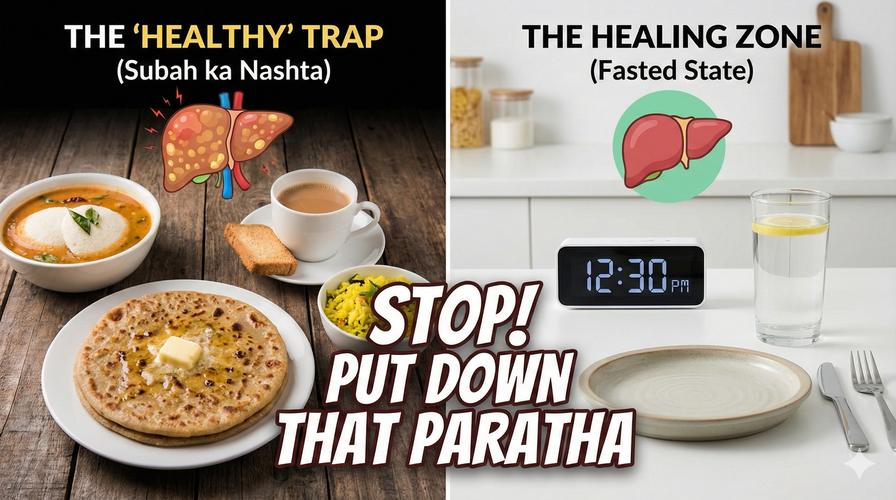
Let’s be honest—we Indians take our breakfast seriously. In our households, leaving the house on an empty stomach isn’t just a bad habit; it’s practically a sin. From childhood, we’ve been drilled with one golden rule by our mothers and grandmothers: “Subah ka nashta raja ki tarah hona chahiye” (Breakfast should be like a king).
Picture this: It’s 8:00 AM. The pressure cooker is whistling, the aroma of ginger-infused chai is wafting through the house, and a plate of hot, buttery aloo parathas, fluffy idlis, or a mountain of poha is waiting for you. Maybe you grab a couple of rusks to dip in your tea, or perhaps you’re trying to be “healthy” so you opt for a fruit smoothie or a bowl of oats. You eat it, feeling virtuous, believing you’ve kickstarted your metabolism for the day.
But what if I told you that this deeply ingrained habit—this “most important meal of the day”—is actually the single biggest reason for your fatigue, your stubborn belly fat, and potentially, your fatty liver?
I know, it sounds like blasphemy. I felt the exact same way. But after diving deep into the science of what happens to our bodies when we wake up, specifically learning from the insights of Dr. Eric Berg, my entire perspective shifted. Today, I want to have a serious, heart-to-heart conversation with you about why skipping breakfast might just be the best health decision you ever make.
The Great Indian Breakfast Myth
We need to talk about what “breakfast” actually means. The word itself is Break-Fast. You are breaking a fast.
When you sleep, you aren’t just resting. Your body is working overtime. For those 7-8 hours of shut-eye, you are in a fasted state. You aren’t eating, so your insulin levels (the hormone that stores fat) drop to their lowest point in the 24-hour cycle. Your liver, which is usually busy processing the constant stream of samosas and rotis we throw at it, finally gets a break.
During the night, your liver shifts gears. It enters a state of autophagy—a fancy biological term that basically means “self-cleaning.” Your body starts recycling damaged cells, cleaning out toxins, and most importantly, it starts burning fat for fuel. When you wake up in the morning, your body is actually a fat-burning machine. You are running on your own reserves.
Then, we walk into the kitchen.
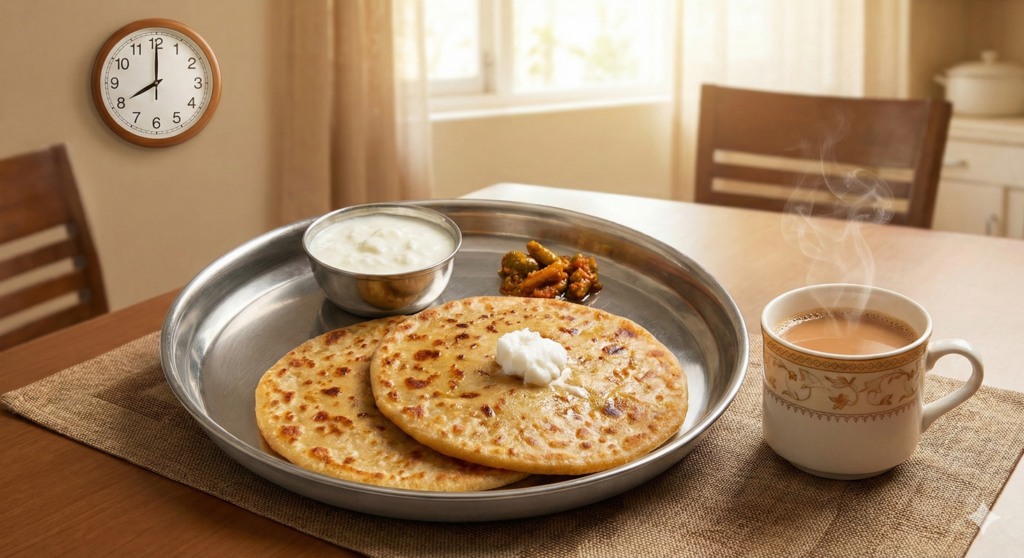
The moment you put that first bite of toast, that first sip of sugary chai, or that spoonful of upma into your mouth, you slam the brakes on this entire process. You jolt your liver out of “repair mode” and force it back into “storage mode.” The fat burning stops instantly.
For years, I thought I was doing the right thing by eating immediately after waking up. I thought I needed the “energy.” But in reality, I was just spiking my insulin and setting myself up for a day of exhaustion.
The “Healthy” Indian Breakfast: A Sugar Trap in Disguise
”But wait,” you might say. “I don’t eat pancakes and waffles like Americans. I eat home-cooked Indian food! Surely that’s healthy?”
This is where we need a reality check. Let’s look at the typical Indian breakfast menu through the lens of insulin response.
1. The Carbohydrate Overload (Poha, Upma, Idli, Dosa)
We love our carbs. Poha is flattened rice. Upma is semolina (wheat). Idli and Dosa are rice and lentil batters. While these are delicious and culturally comforting, they are almost entirely carbohydrates. When you eat them, they break down into glucose very quickly. This causes a blood sugar spike, which demands a massive surge of insulin to manage.
2. The “Light” Snacks (Chai & Biscuits/Rusk)
This is the silent killer. Millions of Indians start their day with “Bed Tea.” Sweet, milky tea accompanied by a Marie biscuit or a rusk. We think, “It’s just one biscuit, what harm can it do?”
Here’s the truth: That rusk is refined flour (maida) and sugar. The tea has sugar. This combination hits your empty stomach like a sugar bomb. It’s not “light”; it’s a metabolic disaster.
3. The Protein + Carb Double Whammy
This was the most shocking part of Dr. Berg’s analysis for me. We often think, “If I have eggs (protein) with my toast (carbs), the protein will balance it out.” Or in an Indian context, “I’ll have chole (protein/carb mix) with puri (fried carb).”
Dr. Berg explains a terrifying mechanism: When you combine carbohydrates with protein, you don’t lower the insulin spike—you double it.
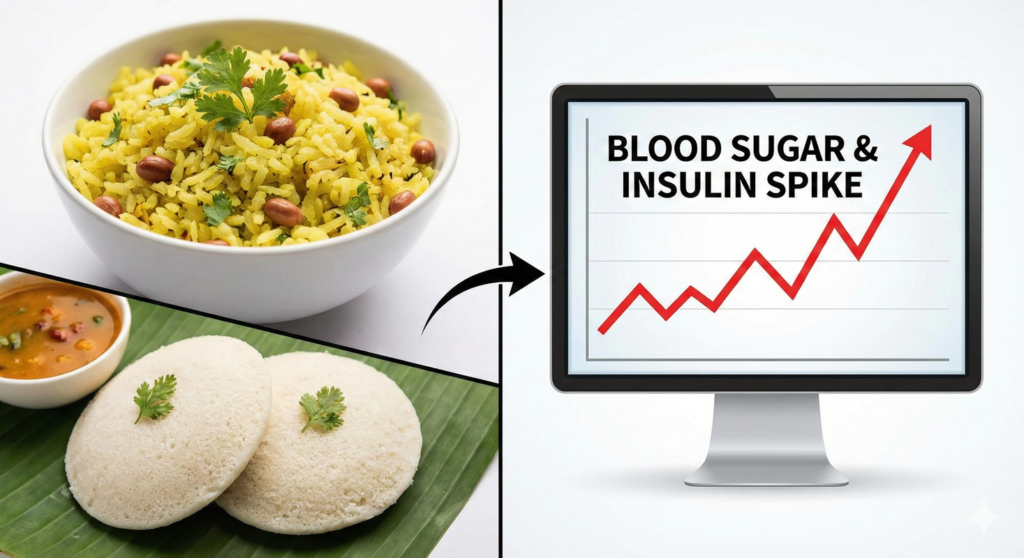
Yes, the protein might slow down the digestion slightly, keeping your blood sugar reading lower, but your insulin—the hormone that causes long-term damage—skyrockets even higher than if you had just eaten the carbs alone. That “balanced” breakfast of egg bhurji and toast is actually flooding your system with insulin.
The Invisible Damage: Why You Feel Tired at 2 PM
Have you ever noticed a pattern in your day? You eat a heavy breakfast at 9 AM. By 11:00 AM, you’re looking for a snack. You have lunch at 1:30 PM (maybe rice and dal). And then, like clockwork, at 3:00 or 4:00 PM, the “afternoon slump” hits. Your eyes get heavy, your focus blurs, and you desperately need a chai or coffee to function.
This isn’t “normal.” This is the blood sugar roller coaster.
When you spike your insulin first thing in the morning with breakfast, you crash a few hours later. This crash triggers hunger hormones. You eat again to fix the low, spiking insulin again. It’s a vicious cycle.
The Consequences are Real:
- Fatty Liver: This is becoming an epidemic in India, even among non-drinkers (NAFLD). When your liver is constantly bombarded with insulin and glucose, it has no choice but to store the excess energy as visceral fat around your organs.
- The “Indian Potbelly”: Have you noticed how many of us have thin arms and legs but a protruding belly? That is classic “insulin belly.” High insulin specifically targets fat storage in the abdominal area.
- PCOS and Hormonal Issues: For Indian women, the rise in PCOS is alarming. Dr. Berg highlights that high insulin increases androgens, leading to PCOS in women. In men, it can lead to hair loss and prostate enlargement.
- Water Retention: If your socks leave a dent in your ankles or your rings feel tight in the morning, that’s often sodium retention caused by—you guessed it—high insulin.
The Solution: Embrace the Fast
So, if Poha is out, and Paratha is out, and even the “healthy” smoothie is out… what should you eat for breakfast?
The answer is: Nothing.
I know, it goes against everything our culture teaches us. But physiologically, skipping breakfast is the most powerful tool you have to reset your health. This is essentially Intermittent Fasting.
By pushing your first meal to 12:00 PM or 1:00 PM, you extend that overnight fasting window from 8 hours to 16 hours. Here is what happens when you do that:
- Liver Healing: You give your liver ample time to finish its “cleaning cycle” (autophagy). It clears out the fat stored in the liver cells.
- Ketosis Kickstart: Without incoming food, your body has to find fuel. It turns to your stored body fat. You finally start “eating” your own belly fat for energy.
- Mental Clarity: This was the biggest surprise for me. I used to think I couldn’t focus without food. The opposite is true. When your body runs on ketones (fat fuel) instead of glucose, your brain fog lifts. You feel sharper and more alert.
- Stable Energy: No more afternoon slumps. No more 4 PM sugar cravings. Your energy becomes a steady line rather than a zigzag graph.
For more insights on life lessons and health, check out our other posts at LifeLessonLab.
How to Start Skipping Breakfast (Without Going Crazy)
If you’ve been eating breakfast your whole life, going cold turkey can be hard. You might feel “hangry” or get a headache initially. This is just your body throwing a tantrum because it’s addicted to the morning sugar hit.
Here is a step-by-step guide to transitioning, Indian style:
Step 1: Fix the Dinner
You cannot skip breakfast if you eat a carb-heavy dinner at 11 PM. Try to eat your last meal by 7:30 or 8:00 PM. Make it lower in carbs—think paneer tikka, chicken, lots of sabzi (vegetables), and maybe just one roti instead of three.
Step 2: The Morning “Crutch”
When you wake up, drink water. Lots of it. If you need something warm, have black coffee or black tea. No sugar. No milk. Milk contains lactose (sugar) which will break your fast. Green tea is excellent.
Note: If you are addicted to chai, this is the hardest part. Try making a masala chai with just water and spices, no milk/sugar. It’s an acquired taste, but it saves your life.
Step 3: Push the Time
Don’t aim for 1:00 PM on day one.
- Day 1-3: Push breakfast to 10:00 AM.
- Day 4-7: Push it to 11:00 AM.
- Week 2: Push it to 12:00 PM.
Eventually, your “breakfast” becomes your lunch. You are now eating two solid meals a day (Lunch and Dinner) with no snacking in between.

Step 4: Listen to Your Body
Dr. Berg makes a crucial point: “Don’t eat if you are not hungry.”
Sometimes we eat just because it’s “time” to eat. Wake up and ask yourself: Am I actually hungry? Or is my mouth just bored? Most of the time, that morning hunger is just habit. Drink water, wait 20 minutes, and the hunger usually disappears.
Final Thoughts: Breaking the Cycle
We live in a country that is rapidly becoming the diabetes capital of the world. Our genetics, combined with our carb-heavy modern lifestyle, is a dangerous mix. We cannot eat the way our grandparents in the villages ate because we don’t move the way they moved. They earned that paratha by working in the fields; we are eating it to sit in a Zoom meeting.
Skipping breakfast isn’t about starving yourself. It’s about aligning your eating window with your body’s natural rhythm. It’s about giving your overworked liver a vacation every single morning.
I tried this myself. The first week was tough—I missed my morning toast. But by week two, the bloating vanished. My clothes fit better. And for the first time in years, I didn’t feel the need to nap after lunch.
So, tomorrow morning, when the aroma of breakfast fills the house, grab a glass of water, smile at the paratha, and say, “Not now. I’ll see you at lunch.”
Your liver will thank you.
Credits & References
This post was inspired by the research and educational content provided by Dr. Eric Berg DC. Dr. Berg is a renowned health educator who specializes in Healthy Keto™ and Intermittent Fasting.
- Primary Source: “NEVER Start Your Morning With This (Destroys Your Liver)” by Dr. Eric Berg DC.
- Watch the original video here: https://youtu.be/DMcL6KiglvM
Disclaimer: I am not a doctor. This content is for informational purposes only and is based on personal research and experiences. Please consult with your healthcare provider before making significant changes to your diet, especially if you are diabetic or on medication.
He is a Blogger and a YouTuber based in Jodhpur.
For years, he chased the 5 AM club, the perfect routines, and the “hustle”—and burnt out twice in the process. He realized that most productivity advice isn’t designed for the real world of traffic jams, family obligations, and noisy neighborhoods.
Through LifeLessonLab, he shares practical, “no-nonsense” systems to help you build a meaningful life without losing your mind.