
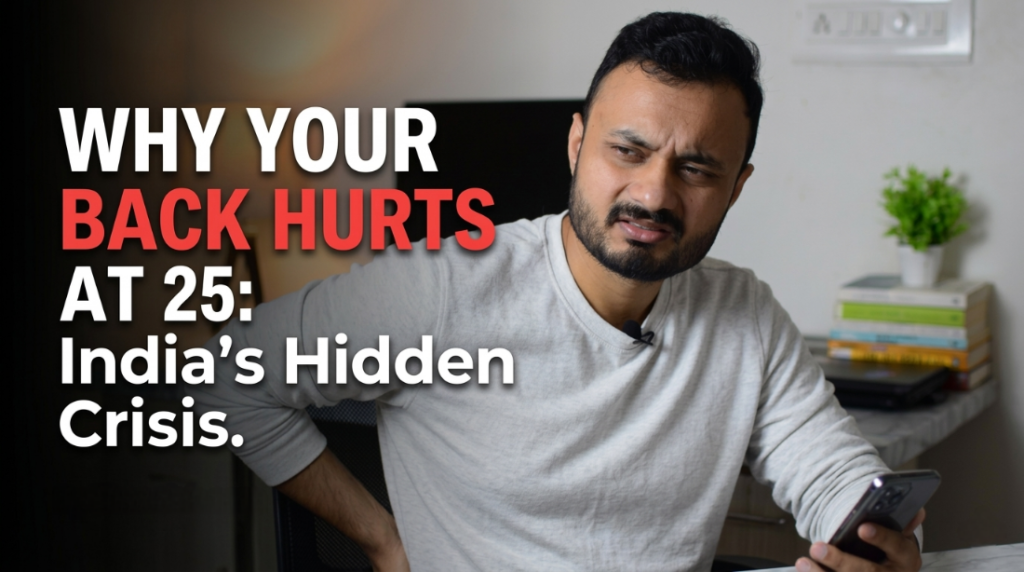
This post accompanies my latest YouTube video on India’s hidden back pain crisis. If you are experiencing back pain at 25, or anywhere in your twenties and thirties, you are not alone. If you’d rather watch than read — click here to watch it. But if you want the longer, more personal version of this story — keep reading. This one goes deeper.
I was diagnosed with a slipped disc in 2019.
I was young. Active enough. No dramatic injury, no accident. Just one day, the pain was there — and then a doctor looked at my scans, looked at me, and said something I wasn’t prepared to hear:
“This is going to be part of your life now.”
I didn’t accept that for a long time. Almost two years, actually. I kept searching for the fix — the right exercise, the right physiotherapist, the right stretch routine that would finally make it go away. Some days the pain was a 2 out of 10. Other days, getting out of bed was its own small victory. And that unpredictability — never knowing what kind of day you’re waking up into — that was honestly harder than the pain itself.
I’m sharing this because I’ve now been living with this condition long enough to have learned some things I wish someone had told me at the very beginning. Not just about the spine — but about how to think about chronic pain, what’s actually causing it in young Indians at an alarming rate, and what the research says versus what most of us actually do.
This isn’t a medical article. I’m not a doctor. This is one person’s lived experience, with data attached.
The Problem Nobody’s Admitting About Back Pain at 25
Here’s a number that should stop you mid-scroll: according to a 2022 Indian-specific systematic review by Shetty et al., over 60% of Indians experience low back pain at some point in their lifetime. That’s 6 out of every 10 people in a country of 1.4 billion.
But the statistic that actually kept me up at night was this: the age group is shifting.
Back pain used to be the complaint of the 45-and-above crowd. Now it’s the 22-year-old college student who sits 10 hours a day. The 26-year-old software engineer whose entire career happens on a chair. The 30-year-old founder running on caffeine, no sleep, and chronic stress. The Global Burden of Disease 2021 report, published in Lancet Rheumatology, confirms that absolute case numbers have been rising steadily since 1990 — driven by population growth and, critically, lifestyle changes.
We’re not getting older faster. We’re just living worse.
The 5 Reasons This Is Happening to Young India
I covered all five in depth in the video, but let me give you the honest version here — the one that includes where I personally went wrong.
1. We sit like it’s a sport.
India’s digital economy boom is genuinely remarkable. IT sector, WFH culture, online education, OTT platforms — all incredible. But the side effect nobody advertised is that we now sit for 8 to 12 hours a day, sometimes barely moving. The GBD 2019 risk factor analysis directly links prolonged sitting to increased low back pain risk. When you sit for hours, your core muscles weaken, your spine absorbs constant compressive load, and your hip flexors tighten — pulling on your lower back like a slow, invisible vice.
The fix is boring but it works: stand up every 30-45 minutes. Two minutes. That’s it. Set an alarm. The reason most people don’t do it isn’t because they can’t — it’s because they underestimate how badly the sitting is hurting them until it’s already too late.
2. Your phone is putting 27 kilos on your neck.
“Text neck” is a real clinical term. When you tilt your head down to look at your phone — the position most of us spend hours in daily — the effective load on your cervical spine at 60 degrees is approximately 27 kilograms. Twenty-seven. That’s not a metaphor. It’s biomechanics.
And it doesn’t stay in your neck. The dysfunction cascades — shoulders round, the lumbar curve flattens, lower back muscles compensate and fatigue. Every hour on the phone in that position is a slow deposit into a debt your spine will eventually collect.
3. Excess weight is a spinal issue, not just a health one.
This one doesn’t get talked about bluntly enough. Every extra kilogram your abdomen carries adds mechanical load to your lumbar spine — 365 days a year, every year. The GBD 2019 risk factor study lists high BMI as a significant independent risk factor for low back pain. Weak abdominal muscles, common with a sedentary, high-processed-food lifestyle, mean your back muscles are doing double duty. They fatigue. Pain follows.
4. Ego lifting at the gym is giving young men disc herniations.
The gym culture boom in India is a good thing. Exercise is genuinely one of the best things you can do for your spine — the WHO 2023 guideline supports exercise-based therapy as a first-line intervention. But there’s a version of gym culture that’s actively dangerous: heavy deadlifts with no form, squats with a rounding lower back, no warmup, no supervision, pure ego.
The worst part? The damage often doesn’t announce itself dramatically. It builds quietly — a little disc irritation here, a small muscle strain there — until one bad set finally tips it over. Form first, always. Weight is secondary. One session with a qualified physiotherapist or personal trainer to learn the basics is not an expense. It’s insurance.
5. The one I figured out last — and the one most people never figure out at all.
This is the one I talk about in the video at length, because it took me nearly two years to understand it personally.
Stress and mental health are not separate from back pain. They are part of it.
After my diagnosis, Initially, I approached it as a purely physical problem. Fix the body, fix the pain. Therefore, I diligently did the exercises. Next, I consulted the physiotherapist. I even improved my ergonomics. Despite all of this, the pain still came and went unpredictably and I grew increasingly frustrated and anxious about it — which, I later learned, was directly making the pain worse.
Both the Global Burden of Disease research and WHO guidelines confirm this: psychosocial stress worsens chronic back pain. Anxiety and depression amplify pain perception — the same physical injury genuinely hurts more when you’re mentally under load. Young India is carrying enormous psychological weight right now. Career anxiety, financial pressure, social media comparison, job uncertainty. The body holds all of it — and for many of us, it holds it in the lower back.
The acceptance — genuinely accepting that this condition is something I manage, not something I defeat — took me about one to two years. And I say this honestly: after that acceptance, the frequency of bad pain days reduced. Not because anything physical changed. Because the mental war I was fighting against my own body finally stopped.
What Actually Helps (The Unsexy, Consistent Version)
I want to be careful here because there’s a lot of noise online about back pain remedies, and most of it either oversimplifies or oversells. Here’s what research and personal experience have both pointed me toward:
Move every 30-45 minutes. Not exercise — just movement. Stand, walk to get water, stretch for 90 seconds. Alarm on your phone. Non-negotiable.
Daily walking or cycling, 20-30 minutes. Consistency over intensity. Always. This is not about fitness — it’s about keeping the spine mobile and the surrounding muscles active.
Three core exercises, three days a week. Pelvic tilt, glute bridge, bird dog. No equipment. Beginner-safe. WHO guideline explicitly supports exercise-based therapy as first-line treatment for low back pain. These three cover the basics. (I demonstrate all three in the video.)
Fix your sitting setup. Screen at eye level. Feet flat on floor. Back supported. Laptop on your lap in bed is not a working position — it is a slow injury in progress.
Sleep 7-8 hours. Seriously. Sleep deprivation increases systemic inflammation and lowers your pain threshold. If you are chronically under-sleeping and wondering why you’re in pain — you have your answer.
Address the stress. Ten minutes of deep breathing daily is not wellness influencer content. It has measurable physiological effects on muscle tension and pain perception. Combined with adequate sleep and social connection, it matters more than most people admit.
If the Pain Has Already Started
If you’re reading this and back pain is already part of your daily life — first, you’re not alone, and it’s not a life sentence.
Do not rest in bed. WHO explicitly states prolonged bed rest worsens low back pain outcomes. Keep moving gently. Use a heat pack for muscle tension. Start physiotherapy early — the earlier you start, the faster the recovery.
Do not jump to an MRI immediately. Imaging is not necessary unless you have red flag symptoms — leg weakness or numbness, bladder or bowel issues, fever alongside back pain, unexplained weight loss, or pain following significant trauma. These need immediate medical attention. Everything else? Start with movement and physiotherapy first.
The Thing I Wish I’d Read at 22
I’m writing this because the version of me from 2018 — before the diagnosis — was doing almost everything on the “how to develop a slipped disc” list. Long sitting hours. Phone posture. Gym without proper form. High stress, low sleep. I didn’t know. Nobody told me, not in a way that felt real or urgent.
The data says 80-90% of low back pain cases are manageable through lifestyle. That means most of this is preventable. That means the choices you make in your 20s are writing the story your spine tells in your 40s.
I’m not here to scare you. I’m here to tell you — from inside the experience — that taking this seriously now is infinitely easier than managing it later.
If you found this useful, share it with someone you know who sits at a desk all day, goes to the gym, or is just in that age where back pain is starting to feel normal. It isn’t normal. It’s just common. And those are very different things.
Watch the full video here:
Drop a comment below or on the video — have you dealt with back pain? How many of the 5 reasons matched your life? I read everything.
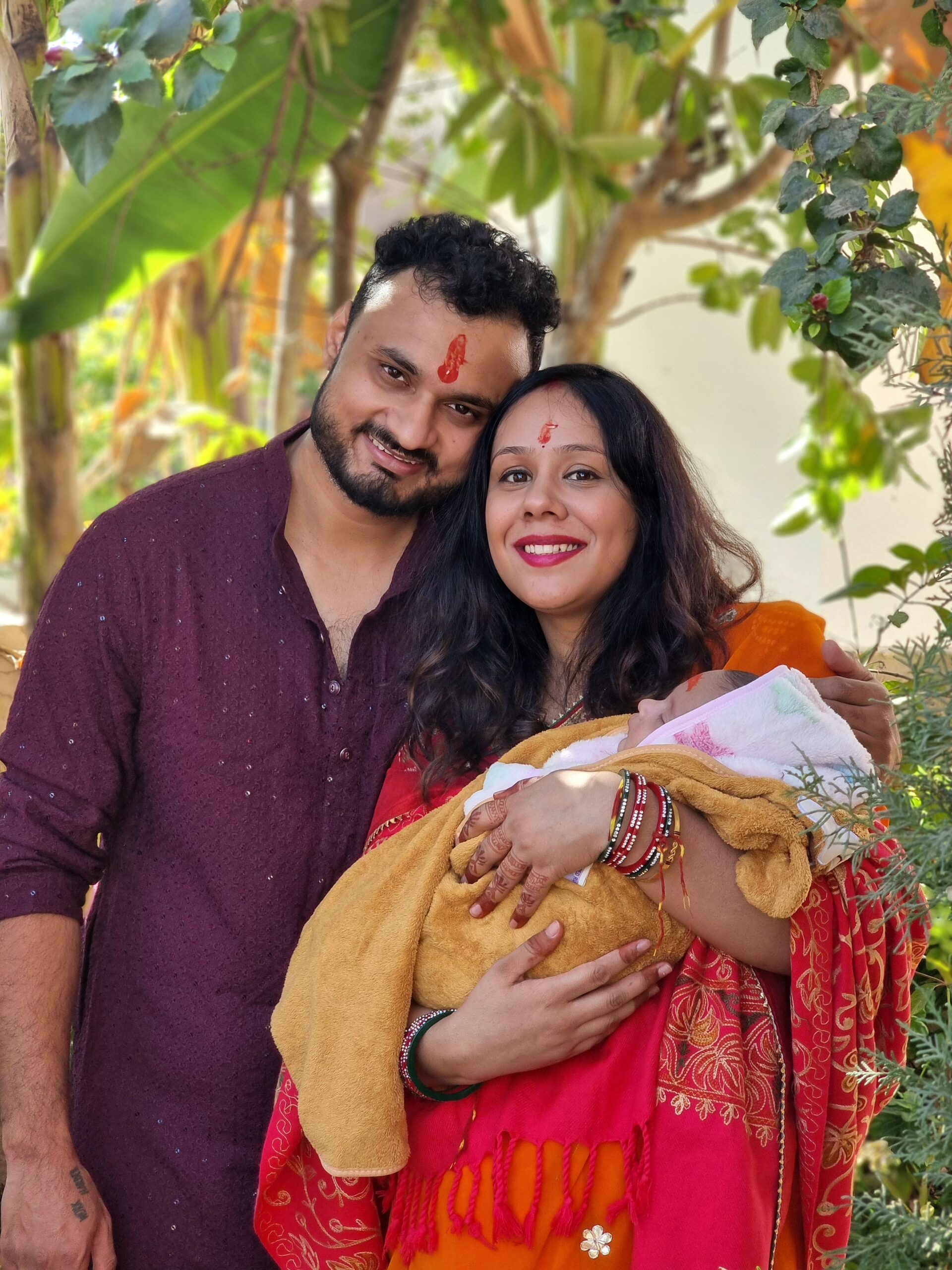
He is a Blogger and a YouTuber based in Jodhpur.
For years, he chased the 5 AM club, the perfect routines, and the “hustle”—and burnt out twice in the process. He realized that most productivity advice isn’t designed for the real world of traffic jams, family obligations, and noisy neighborhoods.
Through LifeLessonLab, he shares practical, “no-nonsense” systems to help you build a meaningful life without losing your mind.
Helpful content. Thank you so much for sharing this article 👍
Thanku ma’am, your support is much appreciated 😇
Thank you for sharing such useful information. Many young people need to be aware of this problem.
Thanku ma’am and yes i want to spread awareness as far as possible. Your support is much appreciated 🙏