
(Why discipline, systems, and energy matter more than motivation)
Let me start with a confession.
Most days, I don’t feel motivated.
Not to work. Not to exercise. Not to write. Not to improve myself.
If you are reading this, you likely want to know how to be more productive. You probably have big goals. But if you’re honest, you often feel too tired to chase them.
There was a time, about three years ago, when I decided I was going to be the “perfect” human. I had watched all the YouTube videos. I had read Atomic Habits, I had a fresh notebook.
I set my alarm for 5:00 AM. The plan was foolproof: Wake up, drink warm lemon water, meditate for 20 minutes, exercise for 45 minutes, read ten pages of a non-fiction book, and then—and only then—start my work with “deep focus.”
Do you know how long that lasted? Three days.
On the fourth day, I snoozed the alarm until 8:30 AM. I woke up with a headache, scrolled through Instagram for 40 minutes while still in bed, skipped the workout, ate a hurried breakfast (parathas, definitely not a protein smoothie), and sat down to work feeling like an absolute failure before the day had even begun.
Yet, everywhere we look—YouTube, Instagram, LinkedIn—we are surrounded by the “Hustle Army.” We see 22-year-old founders claiming they work 16 hours a day. We see influencers posting “Day in My Life” reels where their aesthetic desks are spotless.
In our context, this pressure feels even heavier. It’s not just about trying to be more productive; it’s about survival.
- The Commute: We lose hours in Bangalore traffic, Mumbai locals, or the Delhi Metro.
- The Noise: Our homes are rarely quiet sanctuaries; they are bustling hubs of family, doorbells, and street noise.
- The Expectations: We carry the weight of parents’ expectations, societal timelines, and financial stress.
- The Comparison: “Sharma ji ka beta just got a package of 40 LPA. What are you doing?”
We are constantly told: “Hustle. Work harder. Sleep when you’re dead.”
But nobody tells us how to do it without burning out. Nobody tells us how to be more productive when the maid doesn’t show up, the internet is down, and your relatives have come over for tea unannounced.
This article is not about becoming a productivity robot. I am not going to ask you to take cold showers at 4 AM. This is about becoming consistently effective—even on your bad days, even in a chaotic environment.
Part 1: The Biggest Lie We Are Sold — “You Need Motivation”
The biggest mistake we make is waiting to feel like working.
Motivation is a feeling. It is an emotion. And like all emotions—happiness, anger, sadness—it is temporary. Relying on motivation to get work done is like relying on the weather to plan a picnic. Sure, it’s nice when the sun is out, but you can’t build a life around it.
In India, we often confuse motivation with pressure.
Think about how we studied for board exams or entrance tests (JEE, NEET, CAT). Were we “motivated”? Rarely. We were terrified. We were driven by the fear of failure, the fear of disappointing our parents, and the fear of “Log Kya Kahenge” (What will people say?).
That fear-based engine works when you are 17. But when you are 27 or 35, running on fear leads to one destination: Burnout.
The Truth About High Performers
I have studied successful writers, entrepreneurs, and creators. Here is the secret they don’t put in the Instagram caption: They don’t rely on motivation. They rely on systems.
They work when they are tired. They work when they are sad. They work when they are uninspired. They don’t do it because they have superpowers; they do it because they have removed “willpower” from the equation.
Once you accept that you are not supposed to feel motivated all the time, trying to be more productive becomes simpler. It becomes kinder. You stop beating yourself up for being human.
Part 2: To Be More Productive, Redefine Your Goal
What does a “productive day” look like to you?
For most of us, inherited from our industrial or agricultural roots, productivity looks like exhaustion. If you aren’t tired at the end of the day, did you even work?
We define productivity as: “Doing more things.”
- Checking more emails.
- Attending more meetings.
- Staying late in the office just to show face.
This definition is dangerous. It treats you like a machine. If a machine runs for 24 hours, it produces more. If a human works for 24 hours, they produce garbage.
A Better Definition:
Productivity = Doing the right things, consistently, without destroying your health.
If your system ruins your sleep, makes you anxious, ruins your gut health, or leaves you snapping at your family, it is not productivity. It is slow self-destruction.
Real productivity is not about how many items you crossed off a list. It is about the impact of what you did. Writing one excellent proposal is more productive than replying to 50 irrelevant emails.
Part 3: Understand the Indian Reality (Context Matters)
Most productivity books (like The 5 AM Club or Getting Things Done) are written by Western authors for a Western context.
They assume:
- You have a private home office.
- You have full control over your schedule.
- You live in a relatively quiet, predictable environment.
Now, look at our reality:
- Space is Shared: You might be working from a dining table, or a bedroom shared with a sibling or spouse.
- Interruptions are Cultural: If your mom calls you for lunch, you can’t say, “I’m in a flow state, mother.” You get up and eat. If a neighbor rings the bell, you answer it.
- Infrastructure is Unpredictable: Power cuts, internet outages, and traffic jams are part of the algorithm.
When we try to force “Silicon Valley Productivity” into an “Indian Household,” we fail. And then we blame ourselves.
The Solution? Adapt, Don’t Copy.
Instead of fighting your environment, design around it.
- If your house is loud in the morning, don’t try to do deep work then. Do administrative tasks.
- If your commute is long, don’t doom-scroll. That is your “Reading Time” (via audiobooks).
- If you can’t control your whole day, control just 90 minutes of it.
(See my previous post on Ambitious But Lazy? Here’s How I Finally Broke the Cycle for more tips .
Part 4: Energy > Time (The Real Currency)
You do not lack time. You have the same 24 hours as Ratan Tata or APJ Abdul Kalam had.
You lack usable energy.
Have you ever sat in front of your laptop for three hours, intending to work, but just clicking between tabs? You had the time. You didn’t have the focus.
Managing energy is infinitely more important than managing time if you want to be more productive. In the Indian context, we have four massive “Energy Leaks” that we rarely talk about.
Leak 1: The Diet Coma
Our traditional diet—while delicious—can be a productivity killer if not managed. A heavy lunch of Rice/Roti, Dal, and Sabzi creates a massive glucose spike, followed by a crash around 3:00 PM. That “lazy afternoon” feeling isn’t a character flaw; it’s biology known as the post-prandial dip.
- The Fix: Light lunches. Save the heavy, comforting meal for dinner. If you must have rice, reduce the portion and double the dal/sabzi.
See my previous post on Why I Stopped Fearing Salt and Started Watching My Roti: A Reality Check for the Indian Diet.
Leak 2: The “Yes Sir/Ma’am” Culture
We are raised to be polite. We struggle to say “No” to elders, bosses, or peers. We take on work we don’t have the bandwidth for because refusing feels like disrespect. This leads to resentment and emotional fatigue.
- The Fix: Learn the “Polite Deferral.” Instead of “No,” say: “I can definitely do this, but I am currently finishing [Priority Task]. Can I pick this up on Thursday?”
Leak 3: Emotional Labor
Indian families are close-knit, which is beautiful, but it requires energy. Managing family conflict, worrying about parents’ health, attending weddings you don’t want to go to—this is all work. It drains the same battery you use for your job.
Leak 4: Digital Overload
We are addicted to information. WhatsApp groups, Twitter trends, Instagram Reels. Our brains are processing thousands of pieces of data before 10 AM. By the time we start work, we are already mentally exhausted.
Part 5: The “Low-Motivation” System (Actionable Steps)
So, how do we actually get things done? We need a system that works on our worst days.
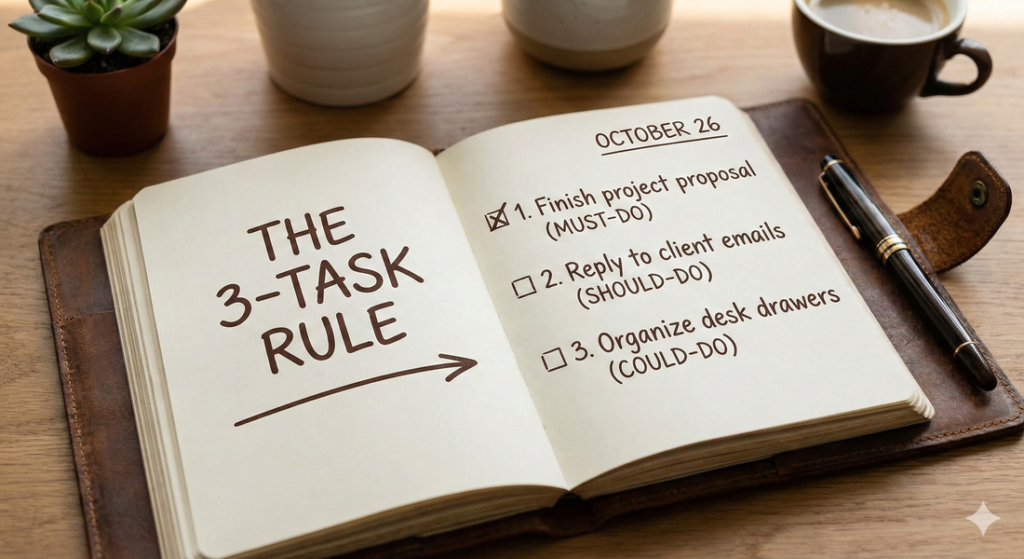
Rule #1: The 3-Task Rule
To-do lists are usually wish lists. We write down 15 things, do 4, and go to bed feeling guilty about the 11 we missed.
The Fix: Every morning (or the night before), write down only three tasks.
- The Highlight: One non-negotiable task. If I only do this today, I will be satisfied.
- The Supporter: A secondary task that needs to be done.
- The chore: One admin task (paying a bill, sending an email).
That’s it.
If you finish them, great! Add more. But if you only do these three, you have won the day. This protects your confidence.
Rule #2: Eat the Frog (But Make it tasty)
Mark Twain famously said, “If it’s your job to eat a frog, it’s best to do it first thing in the morning.”
Translation: Do the hardest thing first.
In India, our mornings can be hijacked quickly. The best time to do your “Highlight” task is immediately. Before the emails pile up. Before the household chaos starts.
The “Tasty Frog” Trick: If the task is hard (e.g., writing a report), pair it with something you love. I only allow myself my favorite expensive coffee while I am doing my hardest task. My brain learns: Hard work = Good Coffee.
Rule #3: The “Do Nothing” Break
When we take breaks, we usually pick up our phones. We scroll Reels.
This is not a break. This is sensory overload. You are feeding your brain more data when it is asking for rest.
The Fix: Take a “Boring Break.”
Stand at the balcony and look at the street. Watch the birds. Make a cup of chai slowly (watch the water boil). Stare at the ceiling.
5 minutes of actual boredom will recharge you more than 30 minutes of Instagram.
Part 6: Navigating the Workplace (The Indian Office)
The Indian workplace has a specific kind of toxicity: Presenteeism.
Bosses often judge you by how long your green dot is active on Teams/Slack, or how late your car is in the parking lot.
How do you survive this?
1. Communication Over-Compensation
If you want to work fewer hours, you must communicate better.
Send an update at the start of the day: “Here are the 3 things I am shipping today.”
Send an update at the end: “Here is what was completed.”
When people see results, they stop watching the clock.
2. The “Fake Meeting” Block
If you work in an open office or a chatty team, you will never get deep work done.
Book a meeting room for yourself for one hour. Or block your calendar as “Strategy Review.” Use that hour for your most important work.
3. Leave Loudly
This is scary, but necessary. When you finish your work, leave. Don’t sit around waiting for the boss to leave. The first few times, it feels awkward. Eventually, you become “the guy who is super efficient and leaves on time.”
Part 7: Digital Boundaries (The Silent Killer)
Our phones are weapons of mass distraction. If you truly want to be more productive, you have to address this.
Most of us spend 4 to 6 hours a day on our screens. That is one-fourth of your life.
If you say “I don’t have time to read” or “I don’t have time to exercise,” check your Screen Time stats. You have the time; you are giving it to Mark Zuckerberg.
The “Phone Foyer” Method:
When you come home from work, or when you sit down to work, put your phone in a different room (or at least out of arm’s reach).
If the phone is on the table, even face down, your brain is using energy to ignore it.
Turn Off Notifications:
Keep notifications on for: Calls and Uber/Swiggy.
Turn them off for: Instagram, WhatsApp, LinkedIn, Email, News apps.
Check these apps on your schedule, not when they buzz you.
Part 8: The “Sunday Scaries” & Recovery
In India, weekends are often as exhausting as weekdays.
Grocery shopping, cleaning, visiting relatives, social obligations. By Sunday evening, the anxiety sets in. The “Sunday Scaries.”
Recovery is not optional. You cannot drive a car at 100 km/h forever; the engine will blow.
The “Do Nothing” Sunday Afternoon:
Protect at least 3 hours on your weekend where you have zero plans.
Sleep. Read. Watch a movie guilt-free.
Do not optimize this time. Do not listen to a productivity podcast. Just be.
Part 9: Separate Self-Worth from Output
This is the deepest and most important point.
We grew up in a system that graded us on everything.
95% marks = Good Child.
60% marks = Average Child.
Fail = Bad Child.
We have carried this scorecard into adulthood.
Promoted = Good Person.
Laid off = Bad Person.
Productive day = I am worthy of love.
Lazy day = I am a waste of space.
This logic is flawed.
You are a human being, not a “human doing.” Your value does not come from your economic output.
Some days, you will be a productivity machine.
Some days, your only achievement will be that you survived the day and didn’t scream at anyone.
Both days are valid.
When you detach your self-worth from your to-do list, a magical thing happens: The anxiety disappears. And when the anxiety disappears, you actually—ironically—become more productive. Because you are working from a place of calm, not a place of panic.
Final Thoughts: The Long Game
I want you to imagine your life five years from now.
Will you remember the Tuesday you stayed up until 2 AM to perfect a PowerPoint slide that nobody read?
Will you remember the Sunday you spent feeling guilty because you didn’t “hustle”?
No.
You will remember the health you built.
You will remember the relationships you nurtured.
You will remember the work you did that actually mattered.
Productivity is a long game. It is a marathon, not a sprint.
If you sprint today, you will collapse tomorrow. If you walk steadily, you will reach the destination—and you will actually have the health to enjoy it when you get there.
So, here is my final request to you:
Read this article. Take one or two ideas that make sense for your life.
And then, close your laptop. Take a deep breath. Drink a glass of water.
And be kind to yourself.
You are doing the best you can in a noisy, chaotic, demanding world.
And that is enough.

He is a Blogger and a YouTuber based in Jodhpur.
For years, he chased the 5 AM club, the perfect routines, and the “hustle”—and burnt out twice in the process. He realized that most productivity advice isn’t designed for the real world of traffic jams, family obligations, and noisy neighborhoods.
Through LifeLessonLab, he shares practical, “no-nonsense” systems to help you build a meaningful life without losing your mind.