
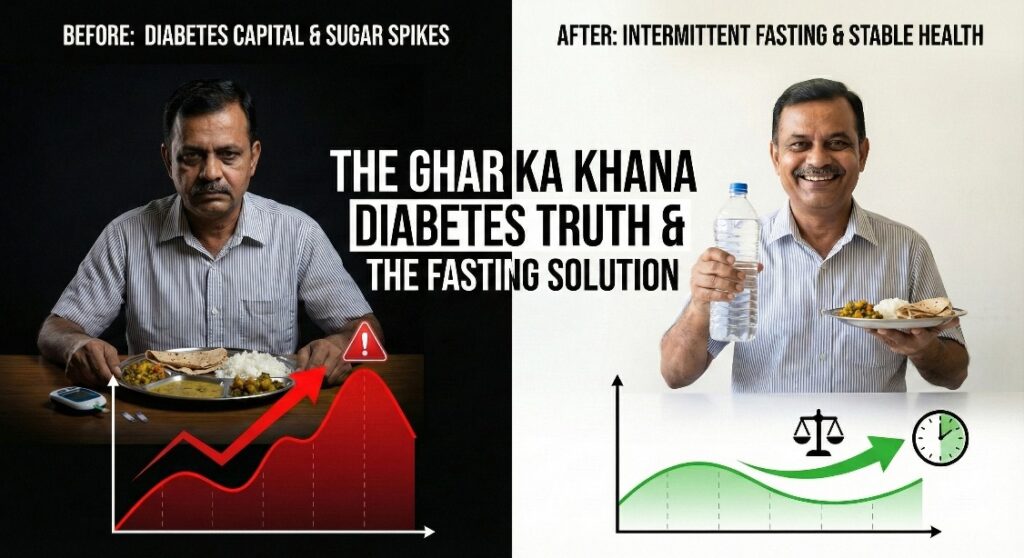
Struggling with Indian diet weight loss? It is a common frustration. India is the diabetes capital of the world despite our love for “Ghar Ka Khana.” Learn why Dr. Jason Fung says homemade food might still be spiking your insulin and how Intermittent Fasting can reverse the trend.
If you’ve been following my journey, you know I’m obsessed with learning—whether it’s wisdom from Kung Fu Panda, lessons for raising my daughter, or understanding how our bodies actually work.
Recently, I listened to a conversation that completely shattered what I thought I knew about health. It was with Dr. Jason Fung, and it wasn’t just “medical advice”—it was a life lesson on how blindly following the crowd can lead us down the wrong path.
Growing up in an Indian household, I’ve watched a confusing pattern play out. We eat fresh, homemade food. We have uncles and aunties who walk religiously. Yet, we struggle with Indian diet weight loss as bellies grow and diabetes medication becomes as common as salt on the table.
I used to think, “If I just count my calories and walk a bit more, I’ll be fine.” However, Dr. Fung made me realize: It’s not our fault. We’ve been playing the game with the wrong rules.
Here are the deep-dive takeaways from this podcast and the changes I’m making.
1. The “Healthy” Home-Cooked Trap
The biggest misconception in Indian diet culture is that “Low Calorie + Homemade = Weight Loss.”
Dr. Fung argues that the body is not a calorie calculator; it is a hormonal thermostat. The main hormone that drives weight gain and diabetes is Insulin. When Insulin is high, your body stores fat. Conversely, when Insulin is low, your body burns fat.
Here is the harsh reality of a typical Indian “Healthy” Meal:
- The Plate: 3 Rotis (Carbs), a big pile of Rice (Carbs), a small bowl of Dal (mostly Carbs/some Protein), and a little bit of Sabzi (Vegetables).
- The Hormonal Impact: Even though this is homemade and fresh, it is a massive glucose bomb. In fact, it spikes your blood sugar almost as fast as a sugary drink.
Your body doesn’t care that your mother made the Roti with love. It only sees a massive influx of glucose, requiring a massive spike of insulin to manage it. Consequently, if we eat like this three times a day, our insulin never drops, and we stay in a state of “Insulin Resistance”—the precursor to Diabetes.
2. The “Refrigerator vs. Freezer” Analogy
I used to think fat was just “extra energy” lying around. But if that were true, why can’t we access it when we are hungry? Why do we get shaky and irritable instead of just burning the fat?
Dr. Fung explains this with a brilliant analogy that added real substance to my understanding:
- Glycogen (Sugar) is the Refrigerator: It’s easy access. When you eat carbs (Roti, Rice, Poha), you fill the fridge. You put food in, you take food out. It’s quick energy.
- Body Fat is the Freezer: This is for long-term storage. It’s in the basement. It’s heavy and locked.
The Problem: High insulin is the lock on the freezer door. In a typical Indian diet, we are constantly filling the refrigerator. We eat breakfast, then a snack, then lunch. Because the fridge is always full, we never need to go down to the freezer. Worse, because our insulin is high all day, the freezer is locked shut. You could be carrying 50 pounds of excess fat (energy) but still feel “starving” because you can’t get the door open.
3. The “Healthy” Indian Breakfast Trap
Let’s look at a concrete example of how we get fooled.
Scenario A: The “Sensible” Breakfast
I used to think a bowl of Poha or instant Oats, maybe with a banana and Bread, was a healthy start.
- The Reality: This is almost 100% processed carbohydrate and sugar. It spikes glucose instantly. Insulin floods the system. Two hours later, the sugar crashes, and I’m starving again, looking for a mid-morning snack. I haven’t burned a single gram of fat.
Scenario B: The Hormonal Fix
Compare that to an omelet with vegetables, or paneer bhurji with a little ghee.
- The Reality: Protein and healthy fats have a minimal impact on insulin. Because insulin stays low, my body can actually access its own energy stores. I stay full until lunch without the “brain fog.”
The Life Lesson: A calorie is not a calorie. 100 calories of cookies tells your body to “store fat.” 100 calories of egg tells your body to “build muscle and stay full.”
4. The “Chai-Biscuit” Epidemic
We need to have an honest conversation about our snacking habits. In our culture, food is love. We show affection with sweets; we bond over tea. But this habit is keeping us sick.
Look at a typical day:
- 8:00 AM: Morning Chai (with sugar) + 2 Marie Biscuits. (Insulin Spike #1)
- 9:30 AM: Breakfast (Poha/Paratha). (Insulin Spike #2)
- 11:30 AM: Office/Work Tea break. (Insulin Spike #3)
- 2:00 PM: Lunch. (Insulin Spike #4)
- 5:30 PM: Evening Chai + Namkeen/Samosa. (Insulin Spike #5)
- 9:00 PM: Dinner. (Insulin Spike #6)
We are spiking insulin six times a day! Our body spends 100% of its time in “Storage Mode” and 0% in “Burn Mode.” Dr. Fung points out that in the 70s, people ate three meals and were thinner. Today, we graze all day and are heavier. I’m realizing that “breaking bread” doesn’t mean we have to be eating bread all day long.
5. Intermittent Fasting: The “How-To” Guide
Dr. Fung is known as the father of modern fasting, but he reminds us this isn’t a new fad—it’s ancient wisdom. It’s Ekadashi. It’s the Jain Chauvihar. We just forgot it.
Here is how I am breaking it down and applying it:
Level 1: The 12-Hour Reset (The Bare Minimum)
- What it is: Eat dinner by 8 PM. Don’t eat breakfast until 8 AM.
- Why: This used to be normal life! It stops late-night snacking, which is the worst for weight gain because melatonin (sleep hormone) blocks insulin secretion, leaving blood sugar high all night if you eat late.
Level 2: The 16:8 Method (The Sweet Spot)
- What it is: You fast for 16 hours and eat all your meals within an 8-hour window.
- My Plan: Skip breakfast. I have black coffee or water in the morning. I break my fast at 12:00 PM (Lunch) and finish dinner by 8:00 PM.
- The “Clean Fast” Rule: This is crucial. During the fasting hours, no milk in the tea, no sugar, no little bites of fruit. Even a splash of milk can trigger insulin and stop the fat-burning process.
Level 3: The 24-Hour Fast (Dinner to Dinner)
- What it is: Once or twice a week, you skip breakfast and lunch, eating only dinner.
- The Magic: This triggers Autophagy. Dr. Fung explained this beautifully—it’s like a cellular recycling program. When you don’t eat for roughly 20+ hours, your body lacks incoming protein, so it starts breaking down old, junky cellular parts to recycle them. It’s literally anti-aging from the inside out.
6. It’s Not About Starving, It’s About “Feasting and Fasting”
The biggest mental hurdle for me was the fear of hunger. Will I faint? Will I lose muscle?
Dr. Fung debunked this with evolutionary logic. If a caveman didn’t eat for a day, did he get weak and tired? No! His body pumped him full of adrenaline and growth hormone so he would have the energy to go hunt.
Fasting actually boosts metabolism. It increases focus. I’ve noticed that on days I skip breakfast, my writing is sharper and my energy is steady—no afternoon slump.
7. It’s About Quality, Not Just Quantity
While fasting handles the “when,” Dr. Fung also addresses the “what.” The modern diet is plagued by ultra-processed foods that have been stripped of fiber.
Fiber acts as an antidote to glucose spikes. It slows down digestion and blunts the insulin response. Processed carbohydrates (white bread, sugar, flour) act like an injection of glucose, causing massive insulin spikes. To heal your metabolism, focus on whole, unprocessed foods that occur in nature.
8. The Lesson for the Next Generation
Raising a daughter has made me hyper-aware of the environment I’m creating. I don’t want her to grow up fearing food or obsessing over calories. Instead, I want her to understand nutrition.
I want our home to be one where:
- We eat Real Food: Less packets, more produce.
- We respect the Fast: The kitchen closes after dinner.
- We understand Sugar: It’s a treat, not a daily staple in every cup of tea.
The Bottom Line: We can’t out-walk a bad diet. And we can’t heal a hormonal problem with a calculator. The lesson here is simple but profound: Quality over Quantity, and Timing over Calories.
I’m going to focus on eating real food, cutting out the mindless snacking, and respecting the fast. It’s a small change, but as with all life lessons, the small shifts create the biggest impact over time.
Conclusion: We Can Fix This
We don’t have to be the Diabetes Capital of the World. Furthermore, it is not our genetic destiny. But we have to stop lying to ourselves that “homemade” automatically means “healthy.”
If we can combine the love and freshness of Ghar Ka Khana with the wisdom of Fasting (giving our bodies a break), we can unlock that freezer, burn the fat, and take control of our health.
Your Action Item: Try it for just one week. Skip the morning biscuit. Eat an early dinner. Give your body a 12-14 hour break. Let me know in the comments how much lighter (and more energetic) you feel.
What do you guys think? Could you skip the morning chai and toast to unlock that “freezer”? Let me know in the comments.
Credits & Further Reading
This post was inspired by a life-changing conversation that every person concerned about their health needs to hear.
- The Expert: Dr. Jason Fung, a Toronto-based nephrologist and world-leading expert on intermittent fasting. He is the author of the best-selling books The Obesity Code and The Diabetes Code, which I highly recommend adding to your reading list.
- The Source: The “Diary of A CEO” Podcast hosted by Steven Bartlett. This specific episode, titled “Exercise Doesn’t Make You Lose Weight! Doctor Jason Fung,” is a masterclass in understanding human metabolism.
You can watch the full, uncut interview here:
I encourage you to watch the full video to get the complete scientific context and share it with your family members who might be struggling with these same issues.
Disclaimer: I am a father and a creator, not a doctor. This information is based on Dr. Jason Fung’s research. If you are on medication for diabetes, please consult your doctor before fasting, as your blood sugar can drop rapidly.
He is a Blogger and a YouTuber based in Jodhpur.
For years, he chased the 5 AM club, the perfect routines, and the “hustle”—and burnt out twice in the process. He realized that most productivity advice isn’t designed for the real world of traffic jams, family obligations, and noisy neighborhoods.
Through LifeLessonLab, he shares practical, “no-nonsense” systems to help you build a meaningful life without losing your mind.
Pingback: Why & How to Quit Sugar: A 5-Step Guide for the Indian Diet - lifelessonlab.com